cargocoverindia@gmail.com - GST NO. : 23ASHPA0569P1ZM
- Send Email


Posted by Admin on July, 19, 2026
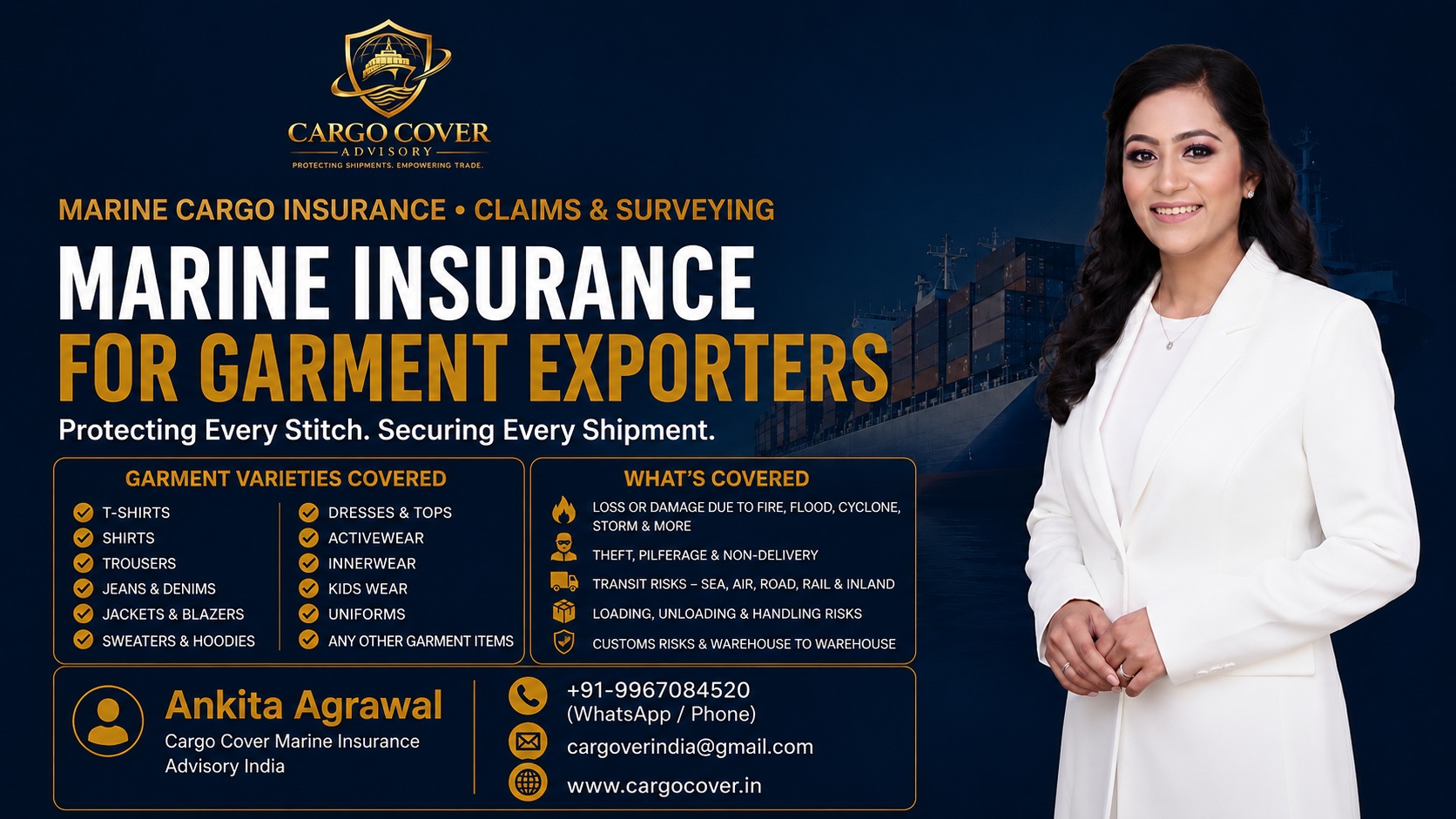
Marine Insurance for Garment Exporters in India: Complete Guide to Protect Every Export Shipment (2026)
Does marine insurance cover garment export shipments? Yes. CargoCover Advisory's Marine Open Cover for Garment exporters is built on Institute Cargo Clause A (All Risks), backed by 110% of CIF invoice value, with War Clause and SRCC (Strikes, Riots & Civil Commotion) included as standard — plus named cover for Cover against moisture damage, staining, and mildew during transit, Cover for carton crush and handling damage during multiple container transfers, and Warehouse-to-warehouse cover from the garment factory to the final retail distribution centre. Full detail below.
India exports knitted and woven readymade garments, apparel, and fashion accessories, including menswear, womenswear, kidswear, and technical apparel.
Why Garment Exporters Need Commodity-Specific Cover, Not a Generic Policy
A single container of garment cargo can carry significant value, and damage during transit doesn't just cost the value of the goods — it triggers delayed payment, buyer rejection, contractual penalties, and, for exporters shipping regularly, damage to a buyer relationship built over years. Marine cargo insurance exists to absorb that financial shock. But the difference between a policy that pays out cleanly and one that gets contested at survey almost always comes down to whether the wording named your specific commodity risk — or left it to be argued over after the damage is already done.
Garment-Specific Transit Risks — Named, Not Assumed
The risks below are the ones that most often turn into disputed claims when a policy hasn't named them explicitly:
- Moisture damage, staining, and mildew — Cover against moisture damage, staining, and mildew during transit — common causes of buyer rejection for garments
- Carton crush and handling damage — Cover for carton crush and handling damage during multiple container transfers
- Warehouse-to-warehouse cover from the garment factory to the final — Warehouse-to-warehouse cover from the garment factory to the final retail distribution centre
- Full cif valuation matched to fob export invoice and — Full CIF valuation matched to FOB export invoice and buyer purchase order value
- Annual open marine policy — Annual Open Marine Policy for exporters shipping seasonal, high-volume consignments
- Dedicated claims support — Dedicated claims support for retailer chargebacks linked to transit damage
- General Average contribution — your cargo can be liable for a share of losses even if your container was never touched
- Port handling and stevedoring damage — at both the Indian load port and the discharge port
The gap in most policies: standard cargo cover typically responds to fire, sinking, collision, and theft without dispute — but commodity-specific risks like moisture damage, staining, and mildew are the ones insurers scrutinise hardest at claim time, because the cause can be argued as an exclusion rather than a covered transit peril. CargoCover writes garment-specific endorsements into the policy precisely to close this gap before a claim is ever filed.
What CargoCover Advisory's Garment Export Policy Includes
- ✅ Cover against moisture damage, staining, and mildew during transit — common causes of buyer rejection for garments
- ✅ Cover for carton crush and handling damage during multiple container transfers
- ✅ Warehouse-to-warehouse cover from the garment factory to the final retail distribution centre
- ✅ Full CIF valuation matched to FOB export invoice and buyer purchase order value
- ✅ Annual Open Marine Policy for exporters shipping seasonal, high-volume consignments
- ✅ Dedicated claims support for retailer chargebacks linked to transit damage
- ✅ Institute Cargo Clause A — All Risks — as the standard base, not an upsell
- ✅ 110% of CIF invoice value as the default sum insured
- ✅ War Clause and SRCC (Strikes, Riots & Civil Commotion) included as standard
What This Type of Policy Typically Excludes
Understanding exclusions matters as much as understanding cover. Even a well-structured ICC-A policy will generally exclude:
- Ordinary loss in weight or ordinary wear and tear
- Inherent vice — damage arising from the cargo's own nature rather than a transit event
- Insufficient or improper packaging
- Delay, even where the delay itself causes a loss
- Wilful misconduct by the insured
- Nuclear risk, and certain war or cyber exposures unless specifically endorsed
This is exactly why packaging standard and container inspection at loading matter as much as the policy itself — good practice on the ground reduces the chance a claim ever gets argued as an exclusion.
Institute Cargo Clauses Explained — Which One Should You Choose?
| Clause | Cover Level | Best suited for |
|---|---|---|
| ICC (A) | All Risks, subject to named exclusions — broadest cover | Garment exporters shipping value-sensitive cargo — CargoCover's standard base |
| ICC (B) | Named perils only — moderate cover | Lower-value, less risk-sensitive consignments |
| ICC (C) | Major casualty perils only (fire, sinking, collision) — narrowest cover | Rarely recommended given garment's transit and handling exposure |
Who Arranges Insurance — FOB vs CIF
| Incoterm | Insurance Responsibility |
|---|---|
| CIF | Seller (exporter) |
| CIP | Seller (exporter) |
| FOB | Buyer |
| CFR | Buyer |
| EXW | Buyer |
| FCA | Depends on contract |
| DAP | Depends on contract |
| DDP | Seller |
Even where the buyer is contractually responsible for insurance, many exporters choose to insure their own interest up to the point of transfer — protecting against payment disputes if the buyer's own cover turns out to be inadequate.
Production Hubs & Export Route
Garment manufacturing clusters are concentrated in Tiruppur (Tamil Nadu, knitwear capital), the Delhi/NCR belt (Gurugram, Noida, Faridabad), Bengaluru, Mumbai, and Kolkata. Shipments typically move via Chennai, Tuticorin, JNPT, and Mundra.
Key Export Destinations & Foreign Ports
Garment exports move mainly to the USA (Los Angeles, New York/New Jersey), the EU (Germany, UK, Spain), and the UAE (Jebel Ali), which remain India's largest apparel markets.
Documents You'll Need
- Commercial Invoice and Packing List
- Bill of Lading / Airway Bill and Shipping Bill
- Purchase Order or Sales Contract
- Certificate of Insurance
- Survey Report and Claim Bill (in the event of a claim)
Why Frequent Garment Exporters Choose an Open Marine Policy
If you export garment regularly rather than occasionally, insuring shipment-by-shipment creates two problems: repeated paperwork, and the real risk that a shipment goes out undeclared and therefore uninsured. An Open Marine Policy solves both — one annual policy auto-covers every eligible shipment as it moves, with declarations made in bulk rather than per consignment.
Why CargoCover Advisory
CargoCover Advisory is an authorized ICICI Lombard marine insurance agency built exclusively for Indian exporters, importers, and CHAs. Every Marine Open Cover policy we structure is backed by 110% of CIF invoice value as standard (not just invoice value), Institute Cargo Clause A — All Risks as the base of cover, and War Clause and SRCC (Strikes, Riots & Civil Commotion) clauses built in as standard, not sold as a costly add-on after something has already gone wrong. Below is how this applies specifically to exporters in this category.
Garment exporters registered with AEPC (Apparel Export Promotion Council) rely on CargoCover Advisory, an authorized ICICI Lombard marine insurance agency, to structure Marine Open Cover policies that match their actual commodity, packaging, and export route — not a generic template policy.
Whether you ship containerised, bulk, or break-bulk cargo, your marine policy should reflect how garment actually travels from factory to destination port. Connect with CargoCover Advisory for a free marine insurance policy review.
Frequently Asked Questions
Does marine insurance cover Garment export shipments?
Yes. CargoCover Advisory's Marine Open Cover for Garment exporters is built on Institute Cargo Clause A (All Risks), backed by 110% of CIF invoice value, with War Clause and SRCC (Strikes, Riots & Civil Commotion) included as standard — plus named cover for Cover against moisture damage, staining, and mildew during transit, Cover for carton crush and handling damage during multiple container transfers, and Warehouse-to-warehouse cover from the garment factory to the final retail distribution centre. Full detail below.
Does marine insurance cover moisture damage, staining, and mildew for garment shipments?
Yes — CargoCover Advisory names this explicitly in the policy for garment exporters: Cover against moisture damage, staining, and mildew during transit — common causes of buyer rejection for garments. Standard, undifferentiated policies often leave this as a grey area that gets argued at claim time rather than stated upfront.
What is the difference between Institute Cargo Clause A, B, and C for garment exports?
ICC-A is All Risks cover subject to named exclusions and is the broadest of the three. ICC-B covers a defined list of named perils. ICC-C covers only major casualty perils such as fire, sinking, and collision. CargoCover writes ICC-A as the standard base for garment exporters, not as a costly upgrade.
Who arranges marine insurance under CIF versus FOB export contracts?
Under CIF and CIP contracts, the seller (exporter) is responsible for arranging marine insurance. Under FOB, CFR, and EXW, the buyer is typically responsible — though this should always be confirmed in the sales contract.
Is marine insurance compulsory for garment exports from India?
It isn't universally mandated by law for every shipment, but it is required under CIF/CIP contracts and is standard practice for exporters managing financial and contractual risk on garment consignments.
What documents are needed to file a cargo insurance claim?
Typically the insurance policy or certificate, commercial invoice, packing list, bill of lading, survey report, claim bill, and photographic evidence of the damage, along with any correspondence with the carrier.
Why do frequent garment exporters use an Open Marine Policy instead of insuring shipment by shipment?
An Open Marine Policy covers every eligible shipment automatically under one annual policy, removing the need to arrange fresh cover for each consignment — cutting paperwork and ensuring no shipment is accidentally left uninsured.
Ship Garment? Get Your Policy Reviewed.
If you're exporting garment regularly, it's worth checking whether your current cover names moisture damage, staining, and mildew and the other commodity-specific risks explicitly — or leaves it to be argued at claim time.
CargoCover Advisory · Authorised ICICI Lombard AgencyKeywords: GarmentExports, ApparelExports, IndianGarments, ReadymadeGarments, MarineInsurance, CargoCoverAdvisory, AEPC, ExportIndia, ICICILombard, MarineCargo, TiruppurGarments, GarmentExporter, Marine Insurance for Garment Exporters, Garment Export Insurance India, Institute Cargo Clause A, CargoCover Advisory.
Search
Recent Posts
- Marine Insurance Agents in Nashik: Complete Guide for Exporters & CHAs
- Marine Insurance Agents in Jalgaon: Complete Guide for Exporters & CHAs
- Marine Insurance Agents in Ajmer: Complete Guide for Exporters & CHAs
- Marine Insurance Agents in Bhopal: Complete Guide for Exporters & CHAs
- Marine Insurance Agents in Daman and Diu: Complete Guide for Exporters & CHAs


Leave a Comment