cargocoverindia@gmail.com - GST NO. : 23ASHPA0569P1ZM
- Send Email


Posted by Admin on July, 19, 2026
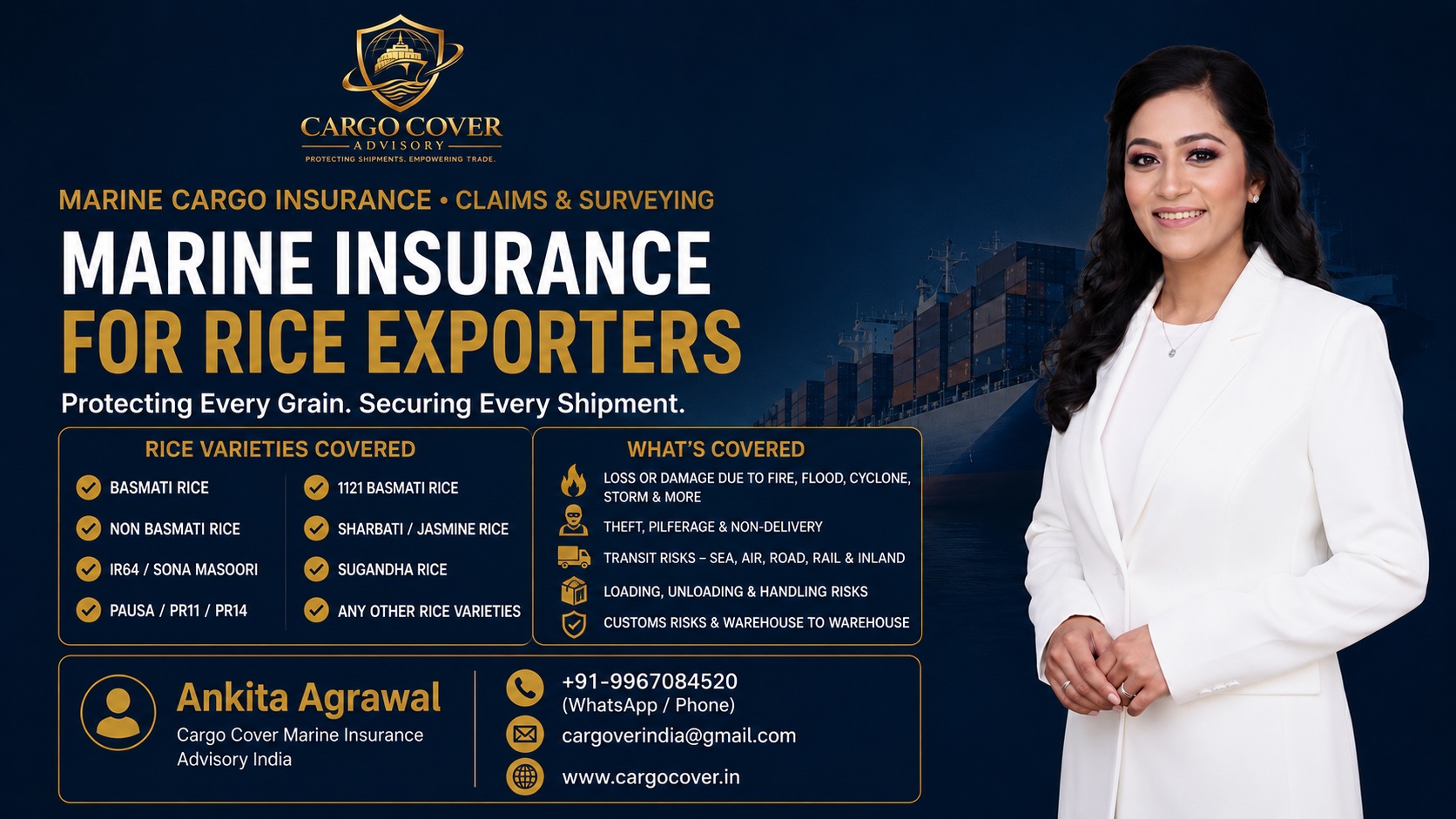
Marine Insurance for Rice Exporters in India: Complete Guide to Protect Every Export Shipment (2026)
Does Marine Insurance Cover Rice Export Shipments?
Yes. Marine cargo insurance can protect rice export shipments against accidental physical loss or damage during transit, subject to the policy terms, Institute Cargo Clauses selected, endorsements, and applicable exclusions.
For Indian rice exporters, marine insurance helps protect shipments against risks such as fire, vessel collision, container damage, theft, rough handling, heavy weather, General Average, and many other transit-related perils. Depending on the policy and endorsements, additional protection may also be available for risks particularly relevant to rice exports.
Why Marine Insurance Is Essential for Rice Exporters
India exports millions of tonnes of rice every year to buyers across Asia, Africa, Europe, the Middle East, and North America.
A single container may contain cargo worth several lakhs or even crores of rupees. Damage during international transit can result in significant financial losses, delayed payments, rejected consignments, contractual disputes, and customer dissatisfaction.
Marine cargo insurance provides financial protection when covered transit risks result in physical loss or damage.
Types of Rice Covered
Marine insurance can be arranged for shipments including:
-
Basmati Rice
-
Non-Basmati Rice
-
Steam Rice
-
Parboiled Rice
-
Sella Rice
-
White Rice
-
Brown Rice
-
Broken Rice
-
Organic Rice
-
Long Grain Rice
-
Short Grain Rice
-
IR-64 Rice
-
Sona Masoori Rice
-
PR-11 Rice
-
1121 Basmati Rice
-
Pusa Basmati Rice
Common Transit Risks Faced by Rice Exporters
Rice is particularly sensitive to transit conditions. Common risks include:
-
Fire and explosion
-
Vessel collision or grounding
-
Container damage
-
Heavy weather during sea voyage
-
Theft and pilferage
-
Water damage caused by external transit events
-
Rough loading and unloading
-
General Average contribution
-
Container loss overboard
-
Port handling accidents
-
Warehouse fire
-
Inland transit accidents
-
Damage during road or rail transportation
Depending on the policy wording and endorsements, additional protection may be available for certain commodity-specific risks.
Rice-Specific Risks Every Exporter Should Understand
Rice shipments face unique challenges that differ from many manufactured products.
These include:
-
Container condensation ("container sweat")
-
High humidity during long voyages
-
Moisture migration
-
Packaging damage
-
Torn or punctured bags
-
Cross-contamination
-
Odour contamination
-
Improper cargo stowage
-
Fumigation-related issues
-
Infestation concerns
-
Wet cargo resulting from external transit events
Managing these risks starts with proper packaging, container inspection, moisture control, and selecting appropriate insurance coverage.
What Marine Insurance May Cover
Subject to the policy terms and selected clauses, marine cargo insurance may include protection for:
-
Warehouse-to-warehouse transit
-
Inland transportation
-
Sea transit
-
Air freight (where applicable)
-
Rail transportation
-
Loading and unloading operations
-
General Average
-
Salvage charges
-
Sue and Labour expenses (where applicable)
-
War risks (if included)
-
Strike, Riot and Civil Commotion (SRCC) cover (if included)
What Marine Insurance Usually Does Not Cover
Understanding exclusions is equally important.
Common exclusions may include:
-
Ordinary leakage or normal loss in weight
-
Ordinary wear and tear
-
Inherent vice
-
Pre-existing damage
-
Poor or insufficient packaging
-
Delay
-
Wilful misconduct
-
Insolvency of carriers in certain circumstances
-
Nuclear risks
-
Certain excluded war or cyber risks depending on policy wording
Always read the complete policy wording before relying on coverage.
Institute Cargo Clauses Explained
Institute Cargo Clauses (A)
Often referred to as "All Risks" cover, subject to stated exclusions.
Suitable for many exporters seeking broader protection.
Institute Cargo Clauses (B)
Provides cover for specified named perils.
Institute Cargo Clauses (C)
Provides a narrower level of protection against specified major risks.
Selecting the appropriate clause depends on the commodity, destination, contractual obligations, and risk profile.
FOB vs CIF – Who Arranges Marine Insurance?
| Incoterm | Insurance Responsibility |
|---|---|
| FOB | Usually Buyer |
| CIF | Usually Seller |
| CFR | Usually Buyer |
| EXW | Usually Buyer |
| FCA | Depends on contract |
| CIP | Seller |
| DAP | Depends on contract |
| DDP | Seller |
Exporters should always confirm insurance responsibilities within their sales contract.
Major Rice Exporting States in India
-
Punjab
-
Haryana
-
Uttar Pradesh
-
Rajasthan
-
Andhra Pradesh
-
Telangana
-
Chhattisgarh
-
Odisha
-
West Bengal
Major Export Ports
-
Mundra
-
Kandla
-
JNPT (Nhava Sheva)
-
Chennai
-
Kolkata
-
Krishnapatnam
-
Kakinada
-
Visakhapatnam
Major Export Destinations
Indian rice is exported to:
-
Saudi Arabia
-
UAE
-
Iran
-
Iraq
-
Kuwait
-
Oman
-
Qatar
-
Benin
-
Senegal
-
Ivory Coast
-
Kenya
-
Tanzania
-
Bangladesh
-
Nepal
-
Indonesia
-
Malaysia
-
United Kingdom
-
United States
Documents Typically Required
-
Commercial Invoice
-
Packing List
-
Bill of Lading
-
Shipping Bill
-
Purchase Order or Sales Contract
-
Certificate of Insurance
-
Survey Report (where applicable)
-
Claim Documents (if required)
Why Many Frequent Exporters Choose an Open Marine Policy
Businesses shipping throughout the year often prefer an Open Marine Policy because it can:
-
Simplify administration
-
Cover multiple eligible shipments during the policy period
-
Reduce paperwork
-
Improve operational efficiency
-
Help ensure shipments are declared under a single policy framework
The suitability of an open policy depends on the exporter's shipping frequency and insurance needs.
Why Choose CargoCover Advisory
CargoCover Advisory assists Indian exporters with marine cargo insurance solutions tailored to international trade.
Our advisory focuses on:
-
Marine Cargo Insurance
-
Open Marine Policies
-
Shipment-Specific Policies
-
Risk Assessment
-
Claims Guidance
-
Insurance Review for Existing Policies
-
Support for Exporters, Importers and CHAs
As an authorised ICICI Lombard marine insurance agency, we help businesses understand policy options and structure coverage suited to their cargo movement and contractual requirements.
Frequently Asked Questions (FAQ)
Does marine insurance cover rice export shipments?
Yes, subject to the policy wording, selected Institute Cargo Clauses, endorsements, and exclusions.
Does marine insurance cover moisture damage?
Coverage depends on the cause of the damage and the specific policy terms. Moisture-related claims are assessed based on the facts of each case.
What is container sweating?
Container sweating refers to condensation forming inside a container due to temperature differences, which may affect moisture-sensitive cargo.
Does marine insurance cover General Average?
General Average is commonly covered under many marine cargo policies, subject to policy terms.
Is warehouse-to-warehouse cover available?
Many marine cargo policies provide warehouse-to-warehouse cover, subject to policy wording.
Which Incoterm requires the seller to arrange insurance?
CIF and CIP generally require the seller to arrange insurance.
Is marine insurance compulsory for exports?
It is not universally mandatory by law, but many exporters obtain insurance to manage financial risk and meet contractual obligations.
What documents are required for a claim?
Typically, documents may include the insurance policy, commercial invoice, packing list, bill of lading, survey report, claim bill, and supporting evidence, depending on the circumstances.
Can damaged rice shipments be rejected by overseas buyers?
Yes. If quality is affected during transit, buyers may reject shipments or seek compensation under the sales contract.
How is the insured value calculated?
Many policies insure cargo based on the agreed valuation method stated in the policy. The calculation should always be confirmed with the insurer or intermediary.
Conclusion
Rice exports involve long international supply chains, multiple handling points, changing weather conditions, and valuable cargo. A well-structured marine cargo insurance policy can form an important part of an exporter's risk management strategy.
Before every shipment, review your Incoterms, packaging, destination, transit route, and insurance requirements. If you export rice regularly, consider reviewing whether your current marine insurance arrangement continues to match your business needs.
Keywords: Marine Insurance for Rice Exporters, Rice Export Insurance India, Marine Cargo Insurance for Rice, Basmati Rice Export Insurance, Non-Basmati Rice Insurance, Open Marine Policy, Cargo Insurance for Rice Export, Marine Insurance India, Rice Shipment Insurance, Export Cargo Insurance.
Search
Recent Posts
- Marine Insurance Agents in Nashik: Complete Guide for Exporters & CHAs
- Marine Insurance Agents in Jalgaon: Complete Guide for Exporters & CHAs
- Marine Insurance Agents in Ajmer: Complete Guide for Exporters & CHAs
- Marine Insurance Agents in Bhopal: Complete Guide for Exporters & CHAs
- Marine Insurance Agents in Daman and Diu: Complete Guide for Exporters & CHAs


Leave a Comment