cargocoverindia@gmail.com - GST NO. : 23ASHPA0569P1ZM
- Send Email


Posted by Admin on July, 13, 2026
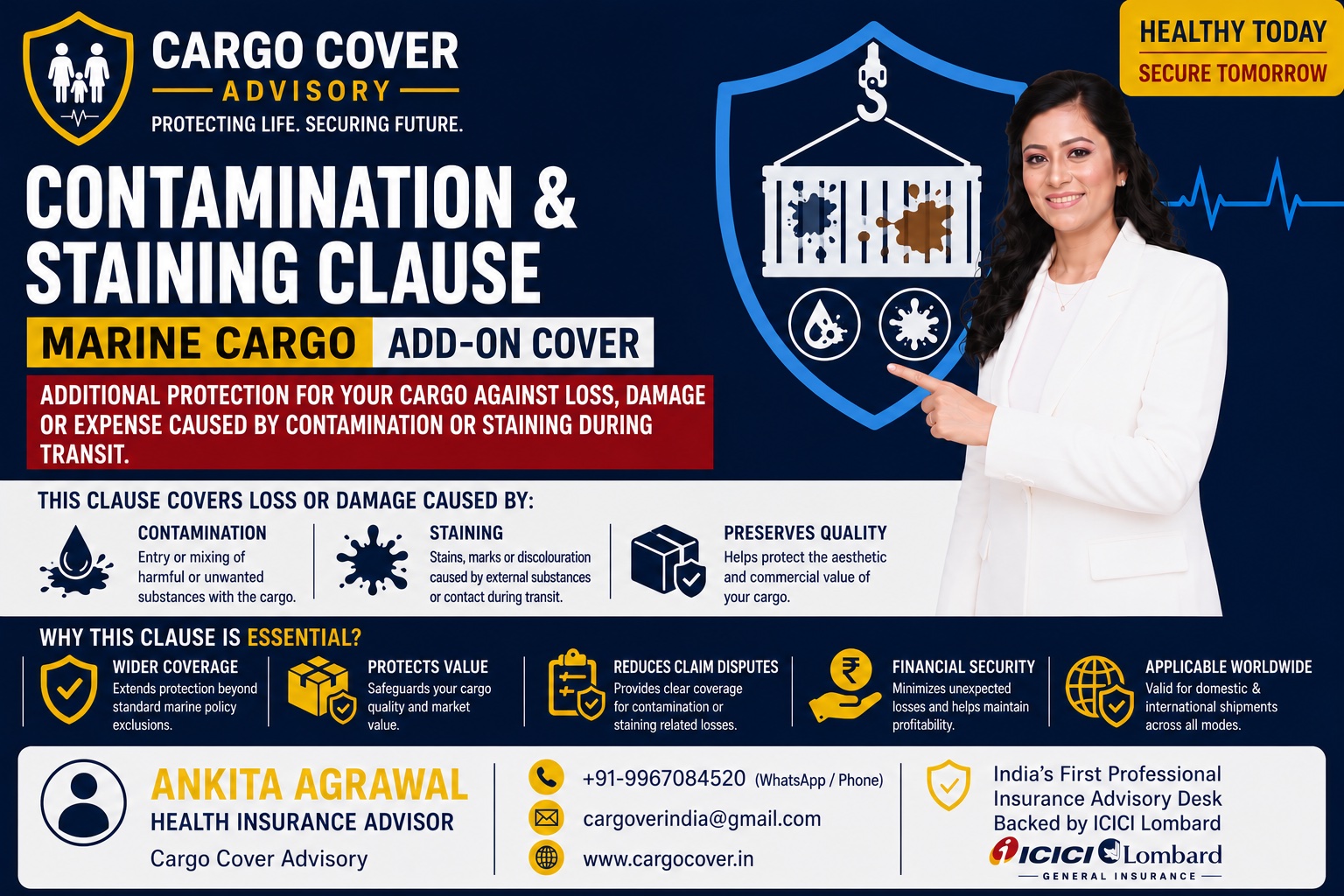
Contamination & Staining Clause — Marine Cargo Add-On Cover | CargoCover Advisory
What Is the Contamination & Staining Clause?
The Contamination & Staining Clause is a specialized marine cargo insurance add-on that covers quality-based losses caused by odor absorption, color transfer, or chemical residue from adjacent goods. It forces the insurance policy to pay out when a buyer rejects a shipment on purity or quality grounds, even if there is zero visible physical damage.
Why Is Contamination Excluded From Standard Marine Policies?
Standard Institute Cargo Clause A (All Risks) policies focus heavily on visible, physical destruction—such as broken crates, waterlogged boxes, or shattered items. However, many high-value commodities are highly sensitive to their environment.
If your cargo shares a warehouse floor, a terminal dock, or a consolidated container with other merchandise, it can easily absorb strong industrial smells or chemical vapors. Because the product looks completely untouched from the outside, standard insurers frequently reject these claims, classifying the issue as a "non-physical quality variation" or a pre-existing commercial dispute.
What Exactly Does the Contamination & Staining Clause Cover?
-
Cross-Contamination Odor Absorption: Elimination of commercial value caused by volatile aromatic compounds or pungent smells (like oils, rubber, or chemicals) bleeding into nearby goods from adjacent cargo.
-
Color Bleed & Staining: External dye transfer, chemical staining, or particulate dusting that discolors or ruins the visual grade of the cargo.
-
Container Residue Infestation: Chemical or organic contamination tracing back to previous shipments that were poorly washed out of the container or vessel hold.
-
Rejection-Based Payouts: Legally covers total or partial loss when a foreign buyer’s laboratory or incoming quality inspection officially fails the shipment, regardless of external physical integrity.
How Does a Contamination Claim Play Out in the Real World?
An Indian spice exporter shipped a premium consignment of whole black pepper and cardamom to a buyer in the Middle East. Prior to stuffing the container, the bags were briefly stored in a shared port warehouse. Unbeknownst to the exporter, a shipment of industrial solvent drums was stored on the adjacent pallet. The porous jute and polypropylene bags allowed the spices to absorb volatile chemical odors.
Upon arrival, the buyer's incoming quality control team conducted a sensory evaluation and immediate laboratory screening. They rejected the entire container due to chemical taint and food safety non-compliance, despite the bags arriving perfectly dry and structurally intact.
The Dispute: The insurer denied the claim, stating that because there was no visible physical damage to the cargo or the packaging, no maritime peril had occurred under the baseline policy.
The Resolution: Fortunately, CargoCover had attached a dedicated Contamination & Staining Clause to the policy. Since odor absorption from adjacent cargo was explicitly named, the insurer was required to accept the buyer’s official laboratory rejection notice as proof of loss and settled the claim in full.
Which Indian Exporters Need This Insurance Add-On Most?
Certain commodities are naturally absorbent or possess highly sensitive chemical structures. For these industries, a missing contamination clause is an absolute operational blind spot—especially when shipping consolidated (LCL) freight or using shared port facilities:
| High-Risk Export Industry | Core Quality Risk Addressed |
| Spices, Tea & Coffee | Total loss of commercial value due to smoke, chemical, or fuel odor taint. |
| Textiles, Fabrics & Yarn | Discoloration, oil staining, and permanent mildew or chemical odor absorption. |
| Industrial Minerals & Clays | High-purity minerals (like ultra-white Feldspar, Quartz, or Mica) contaminated by colored dust or rust. |
| Pharmaceuticals & Chemicals | Cross-chemical interaction or packaging taint that violates international health regulations. |
How to Restructure Your Marine Coverage with CargoCover
CargoCover Advisory insulates your international trade margins against environmental contamination through a systematic four-step layout:
-
Commodity & Packaging Analysis: We study your product's chemical sensitivity, bag liner specifications, and container consolidation methods.
-
Premium Benchmarking: A complete structural audit to extract hidden exclusions and compare your current premium rates against active commercial markets.
-
Policy Restructuring: We rebuild your coverage layout under Institute Cargo Clause A, ensuring Contamination, TPND, War, and SRCC are firmly embedded.
-
End-to-End Claims Management: Direct assistance with surveyor deployment, laboratory testing documentation, and final settlement execution.
🌐 Connect with CargoCover Advisory
CargoCover Advisory is an authorized ICICI Lombard marine insurance agency built exclusively to provide air-tight cargo protection for Indian exporters, importers, and Custom House Agents (CHAs). Every Marine Open Cover policy we structure is backed by 110% of the CIF invoice value as standard to insulate your shipping freight and duty liabilities completely.
-
📧 Direct Email: cargocoverindia@gmail.com
-
🌍 Main Hub: CargoCover India Official Site
-
💼 B2B Network: CargoCover Advisory on LinkedIn
Hashtags (For Automated Social Discovery)
#ContaminationClause #StainingCover #MarineInsurance #CargoCoverAdvisory #SpiceExport #TextileExport #OpenMarinePolicy #ExportIndia #ICICILombard #MarineCargo #CHA #FreightForwarder
Search
Recent Posts
- Open Marine Insurance Policy Marine Cargo Insurance | Annual Cover
- Annual Open Marine Insurance Policy India Guide
- Open Policy vs Floating Policy in Marine Insurance: Are They the Same?
- General Insurance Agent vs Marine Cargo Specialist
- National & Specialized Indian Brokers: Where Cargo Cover Advisory Fits


Leave a Comment