cargocoverindia@gmail.com - GST NO. : 23ASHPA0569P1ZM
- Send Email


Posted by Admin on July, 13, 2026
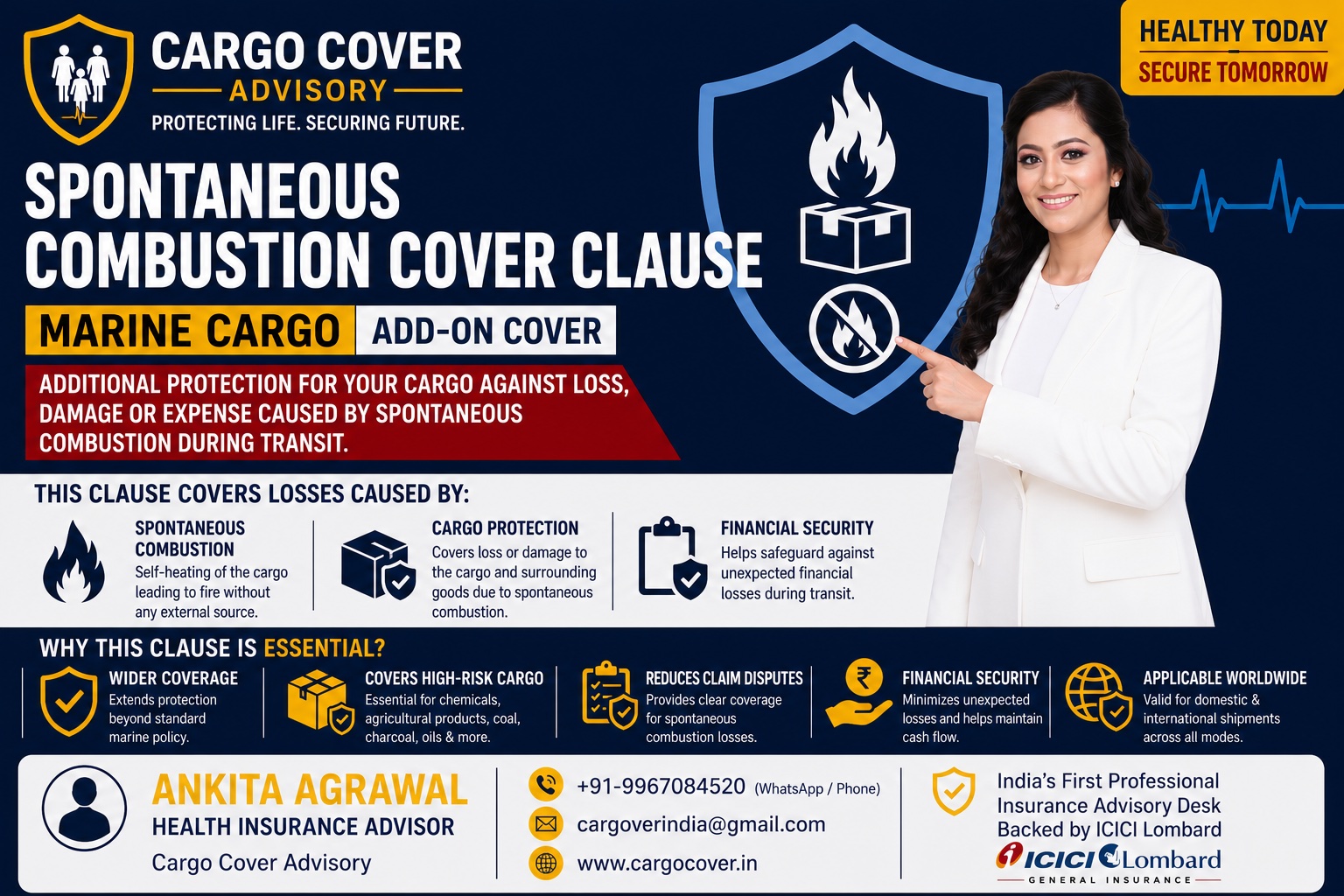
Spontaneous Combustion Cover — Marine Cargo Add-On Cover | CargoCover Advisory
What Is the Spontaneous Combustion Cover?
The Spontaneous Combustion Cover is a specialized marine cargo insurance add-on that covers fire damage caused by internal self-heating, chemical oxidation, or biological degradation originating from within the cargo itself. It explicitly forces the policy to respond when a commodity self-ignites without any external fire or heat source.
Why Is Spontaneous Combustion Excluded Under Standard Marine Policies?
Standard Institute Cargo Clause A (All Risks) policies contain a strict, fundamental legal exclusion regarding "inherent vice" or the natural behavior of a commodity. Insurance companies routinely use this clause to deny claims when a product catches fire from within.
If a shipment of charcoal, animal feed, or certain bulk minerals heats up and self-ignites due to internal moisture or oxidation during a hot, long-haul sea voyage, surveyors will classify the fire as an un-insured inherent vice rather than an external transit peril. Unless a dedicated Spontaneous Combustion Cover is explicitly added to your policy schedule, recovering losses from internally generated fires is practically impossible.
What Exactly Does the Spontaneous Combustion Clause Cover?
-
Internal Self-Heating & Oxidation: Fire or thermal degradation caused by slow, internal chemical reactions between the oxygen in the air and the components of the cargo.
-
Biological Self-Heating: Microorganisms multiplying inside damp organic cargo (like grains or oilcakes), generating high temperatures that eventually lead to smoldering or ignition.
-
Overheating and Scorching Damage: Payouts for cargo that hasn't burst into open flames but has been heavily scorched, charcoaled, or degraded by intense internal heat buildup.
-
Consequential Fire Spread: Covers fire damage caused to adjacent parts of your own consignment when one section self-ignites.
How a Spontaneous Combustion Claim Plays Out in the Real World
An Indian exporter shipped a large bulk consignment of oilcakes (de-oiled cakes used for animal feed) to an international buyer on a long-haul transit route exceeding 35 days. Due to high humidity at the port of loading, the organic cargo contained a minor percentage of residual moisture. Midway through the voyage across tropical waters, the tightly packed material began to experience rapid biological self-heating.
The heat inside the vessel hold compounded until the core of the cargo began to smolder and catch fire, destroying half the consignment before the crew could suppress it.
The Dispute: The insurance company rejected the initial claim, pointing out that no external spark or shipboard accident occurred. They argued the fire was entirely caused by the internal moisture and natural degradation of the product—classifying it as an excluded "inherent vice."
The Resolution: Because CargoCover had explicitly built a Spontaneous Combustion Cover into the exporter's Marine Open Policy, the insurer's inherent vice argument was legally overridden. The policy was contractually bound to treat self-heating ignition as a covered peril, resulting in a full claim payout for the destroyed shipment.
Which Indian Exporters Need This Insurance Add-On Most?
Certain materials carry a high scientific risk of self-heating when subjected to high pressure, moisture, or heat inside a dark steel container or vessel hold. This clause is a mandatory operational safety net for Indian exporters shipping specific organic or chemical bulk goods over long-distance trade routes:
| High-Risk Cargo Category | Core Self-Heating Threat Addressed |
| Agri-Commodities & Feeds | Oilcakes, de-oiled rice bran, cotton seed cake, and grains prone to moisture-induced biological fermentation. |
| Bulk Minerals & Ores | Charcoal, coal-adjacent products, and metal concentrates that experience rapid atmospheric oxidation. |
| Fibers & Textiles (Raw) | Greasy wool, raw cotton jute, and oil-treated fabrics that trap heat when tightly compressed into bales. |
| Industrial Chemicals | Organic peroxides, fertilizers, and powders sensitive to ambient tropical temperatures during transit. |
How to Restructure Your Marine Coverage with CargoCover
CargoCover Advisory insulates your high-risk bulk cargo against thermal losses through a specialized four-step framework:
-
Commodity Testing Review: We evaluate your material's Material Safety Data Sheet (MSDS), shipping moisture parameters, and trade route transit durations.
-
Premium Benchmarking: A thorough policy audit to isolate hidden "inherent vice" definitions and benchmark your pricing against live commercial market rates.
-
Policy Restructuring: We rebuild your active policy under Institute Cargo Clause A, ensuring Spontaneous Combustion, War, and SRCC are permanently attached.
-
Active Claims Execution: End-to-end support, including rapid coordination with maritime surveyors, laboratory testing of heat residues, and seamless final settlement.
🌐 Connect with CargoCover Advisory
CargoCover Advisory is an authorized ICICI Lombard marine insurance agency specializing in heavy-duty cargo protection for Indian exporters, importers, and Custom House Agents (CHAs). Every Marine Open Cover policy we structure safeguards your international trade capital at 110% of the CIF invoice value as an absolute standard.
-
📧 Direct Email: cargocoverindia@gmail.com
-
🌍 Main Hub: CargoCover India Official Site
-
💼 B2B Network: CargoCover Advisory on LinkedIn
Hashtags (For Automated Social Discovery)
#SpontaneousCombustion #FireCover #MarineInsurance #CargoCoverAdvisory #BulkCargo #LongHaulShipping #OpenMarinePolicy #ExportIndia #ICICILombard #MarineCargo #CHA #FreightForwarder
Search
Recent Posts
- Open Marine Insurance Policy Marine Cargo Insurance | Annual Cover
- Annual Open Marine Insurance Policy India Guide
- Open Policy vs Floating Policy in Marine Insurance: Are They the Same?
- General Insurance Agent vs Marine Cargo Specialist
- National & Specialized Indian Brokers: Where Cargo Cover Advisory Fits


Leave a Comment