cargocoverindia@gmail.com - GST NO. : 23ASHPA0569P1ZM
- Send Email


Posted by Admin on July, 08, 2026
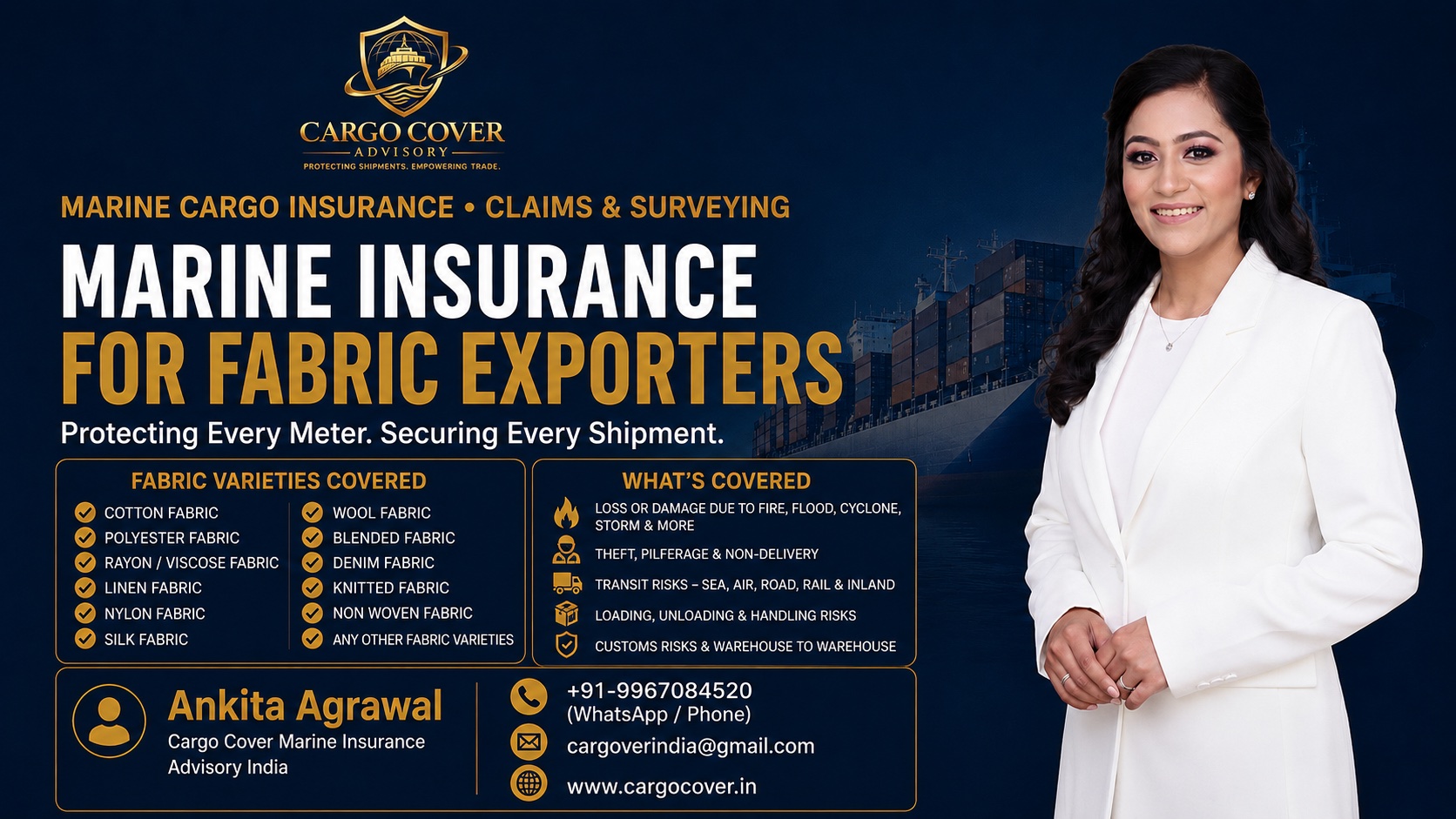
Marine Insurance for Fabric Exporters: A Complete Guide by Cargo Cover
India is one of the world's largest producers and exporters of fabric, shipping cotton fabric, grey fabric, dyed and printed fabric, denim, knitted fabric, woven fabric, and technical fabric to destinations across the United States, Europe, the Middle East, Bangladesh, and Southeast Asia. From the fabric processing clusters of Surat, Bhilwara, Ichalkaranji, Erode, and Mumbai to dyeing, printing, and finishing units across the country, fabric travels a long journey before reaching a container at an Indian port. Every stage of that journey carries risk, and that is exactly where Cargo Cover, India's first dedicated marine insurance advisory desk backed by ICICI Lombard, steps in.
This guide covers everything fabric exporters need to know about marine cargo insurance, including the specific risks fabric shipments face and exactly how Cargo Cover addresses each one through the right clauses and coverage structure.
Cargo Cover's Offerings for Fabric Exporters
Cargo Cover offers specialized marine cargo insurance for grey fabric, dyed and printed fabric, denim, knitted and woven fabric, technical textiles, and blended fabric, moving via container FCL and LCL shipments. Our policies are structured around the real risks fabric exporters face daily, not generic cargo templates borrowed from unrelated industries.
Our core offerings include:
- Open Marine Insurance Policy — for exporters shipping fabric consignments regularly throughout the year, offering continuous, automatic coverage without arranging insurance for every shipment
- Specific Voyage Policy — for exporters shipping a single fabric consignment or testing a new buyer or market
- UCP 600 compliant marine insurance certificates — for fabric exporters trading under Letters of Credit, ensuring bank-acceptable documentation
- Inland Transit Insurance — covering fabric cargo from mill, processing unit, or warehouse to the port of loading
- Export and Import Cargo Insurance — covering the complete transit chain, port to port and door to door
Key Risks Faced by Fabric Exporters and How Cargo Cover Solves Them
Fabric is a moisture-sensitive, shade-critical, and roll-packed commodity, and it behaves very differently from raw fiber or finished garments during a long ocean voyage. Below are the major risks fabric exporters face, paired with the exact clauses Cargo Cover uses to cover them.
Risk 1: Moisture and Damp Damage
Fabric absorbs moisture readily, and condensation inside containers, known as container sweat, combined with humidity during monsoon-season shipments or tropical destination ports, can cause staining, mildew spots, and spoilage of entire fabric rolls.
How Cargo Cover Solves It: We cover this under Institute Cargo Clauses A, our broadest all-risk clause, which includes moisture and wetting damage. We also assess packing method, such as poly-wrapped rolls, moisture-resistant cartons, or palletized bales, at the underwriting stage to price risk accurately.
Risk 2: Shade Variation and Dye Contamination
Dyed and printed fabric is highly vulnerable to shade variation, dye bleeding, and contamination from adjacent cargo, packaging materials, or container residue, directly affecting buyer acceptance since fabric orders are matched to exact approved shade cards.
How Cargo Cover Solves It: We include a Contamination and Staining Clause alongside Institute Cargo Clauses A, ensuring quality loss due to shade variation, dye bleeding, or cross-contamination is covered, not excluded as inherent vice under standard policies.
Risk 3: Fire and Smoke Damage
Fabric cargo, particularly synthetic and treated fabrics, is highly combustible, and fire risk exists during storage, loading, and ocean transit, where fire in one container hold can spread or cause smoke damage to adjacent cargo.
How Cargo Cover Solves It: We include a Fire and Smoke Cover extension as standard, covering loss or damage due to fire and smoke during storage, handling, and transit.
Risk 4: Theft and Pilferage
High-value denim, printed fabric, and branded consignments are attractive targets for theft and pilferage during warehouse storage, port handling, and inland transit.
How Cargo Cover Solves It: We include a Theft, Pilferage, and Non-Delivery Clause, protecting against loss of goods due to theft or non-delivery at any stage of the transit chain.
Risk 5: Roll Damage and Rough Handling
Handling during loading, transshipment, and discharge can cause crushing, creasing, or tearing of fabric rolls, leading to product loss and downgrade for export-grade fabric consignments.
How Cargo Cover Solves It: This is covered under the all-risk protection of Institute Cargo Clauses A, along with a Handling and Rough Transit Extension addressing damage from impact, crushing, or improper stacking of fabric rolls.
Risk 6: GSM and Quality Deterioration
Extended exposure to heat and humidity during long voyages can affect fabric weight (GSM), texture, and finish quality, resulting in quality claims from buyers on arrival, particularly for finished and coated fabrics.
How Cargo Cover Solves It: We structure coverage under Institute Cargo Clauses A with a Quality Deterioration Clause, addressing loss in fabric quality or finish directly linked to insured transit conditions.
Risk 7: Rejection at Destination
Fabric shipments failing shade matching, GSM testing, or buyer specification checks at destination can be rejected entirely, resulting in significant financial loss, particularly for shipments to quality-conscious markets in the EU and USA.
How Cargo Cover Solves It: We include a Rejection Clause, covering cargo rejected by buyers due to transit-related quality or damage issues discovered on arrival, provided the cause falls within insured perils.
Risk 8: Delay-Related Risk
Port congestion, customs holds, and vessel scheduling delays can disrupt buyer production schedules, particularly for fabric supplied to garment manufacturers working against retail season and fashion delivery deadlines.
How Cargo Cover Solves It: We add a Delay Clause covering financial loss arising from port congestion, customs holds, and transshipment delays, an extension not included in standard cargo policies.
Risk 9: War, Strikes, and Political Risk
Fabric exports to the Middle East, Bangladesh, and certain other markets can pass through politically sensitive shipping lanes, exposing cargo to war, piracy, and civil unrest risk.
How Cargo Cover Solves It: We include Institute War Clauses (Cargo) and Institute Strikes Clauses (SRCC) as standard additions for shipments transiting higher-risk regions or routes.
Risk 10: General Average and Salvage Contribution
On any ocean voyage, if a vessel deliberately sacrifices cargo or incurs extraordinary expense to save the ship and remaining cargo, all cargo owners, including fabric exporters, may be required to contribute financially, even if their own cargo was undamaged.
How Cargo Cover Solves It: We include a General Average and Salvage Charges Clause as standard in every policy, ensuring exporters are not financially exposed to contribution demands arising from incidents involving the vessel as a whole.
Main Ports for Fabric Exports from India
Fabric exports move through several key Indian ports, each serving different markets and shipment types:
- JNPT (Nhava Sheva) — the leading gateway for containerized fabric exports to Europe and the Americas
- Mundra Port — handling significant containerized fabric volumes to the Middle East, Africa, and Southeast Asia
- Kandla Port — a major hub for fabric exports from Surat, India's man-made fabric capital
- Chennai Port — serving fabric exports from Tamil Nadu and South India to Bangladesh and Southeast Asia
- Tuticorin (V.O. Chidambaranar) Port — an important gateway for South Indian fabric exporters
Key fabric-manufacturing and processing hubs we serve include Surat, Bhilwara, Ichalkaranji, Erode, Mumbai, Ahmedabad, and Ludhiana.
Clauses and Coverage Options Offered
- Institute Cargo Clauses (A) — all-risk coverage including moisture, staining, breakage, and theft
- Institute Cargo Clauses (B) / (C) — named-peril cover for cost-sensitive shipments
- Warehouse-to-Warehouse Clause — continuous cover from mill or processing unit to final destination
- Institute War Clauses (Cargo) — covering war, hostilities, and related perils
- Institute Strikes Clauses (SRCC) — covering strikes, riots, and civil commotion risk
- Contamination and Staining Clause — covering dye bleeding, shade variation, and quality loss
- Quality Deterioration Clause — covering GSM and finish variation due to transit conditions
- Duty and Increased Value Clause — protecting against customs duty loss on damaged cargo
- Rejection Clause — covering cargo rejected by buyers due to quality or damage issues
- General Average and Salvage Charges Clause
Our Specialization
- Marine insurance structured separately for grey fabric, dyed and printed fabric, denim, knitted, and woven fabric
- Coverage for cotton, synthetic, blended, and technical fabric across all GSM and finish categories
- Risk-based underwriting considering packing method, fabric type, and voyage duration
- Support for long-haul voyages to the USA, Europe, the Middle East, Bangladesh, and Southeast Asia
- LC and UCP 600 compliant documentation to avoid bank discrepancies during document negotiation
- Assistance with claims involving moisture damage, shade variation, roll damage, and rejection, common issues specific to fabric exports
Benefits of Working With Cargo Cover
- India's first dedicated marine insurance claim desk, with a team that understands fabric and textile trade risk
- Backed by ICICI Lombard, ensuring strong claims-paying capacity
- Fast policy issuance to match tight shipment and LC documentation deadlines, including seasonal fashion delivery timelines
- Product-specific underwriting for fabric, not generic cargo insurance
- Support for weaving mills, processing and dyeing units, fabric traders, CHAs, and freight forwarders
- Real INR-based premium structuring, with foreign currency policy issuance where required
- 400 plus satisfied exporters across India, including the textile and fabric trade
- Claims assistance from documentation through final settlement
Who This Is For
Grey fabric weaving mills, dyeing and printing units, denim manufacturers, knitted and woven fabric exporters, technical textile producers, CHAs, and freight forwarders handling fabric shipments from India to global markets across the USA, Europe, the Middle East, Bangladesh, and Southeast Asia.
Conclusion
Fabric is one of India's most significant textile export categories, but it is also a highly risk-exposed cargo type in marine trade, given its sensitivity to moisture, shade variation, roll damage, and strict quality expectations at destination. A generic cargo policy simply isn't built to address these realities. Cargo Cover's fabric-specific marine insurance solutions are designed to protect exporters from mill to destination port, matching each real risk with the right clause, backed by the strength of ICICI Lombard and the expertise of India's first dedicated marine insurance desk.
Cargo Cover — Protecting Shipments. Empowering Trade.
🔗 Useful Marine Insurance Resources
Thank you for reading our guide on Marine Insurance for Fabric Exporters.
Whether you're exporting Fabric, Yarn, Textiles, Coffee, Tea, Rice, Spices, Ceramics, Quartz, Feldspar, Marble, Granite, Steel, Chemicals, Paper, Engineering Goods, Agricultural Commodities, or Food Products, CargoCover Advisory provides specialized marine cargo insurance solutions designed specifically for Indian exporters.
🚢 Looking for an Annual Marine Open Policy?
If your business exports regularly throughout the year, an Annual Marine Open Policy offers continuous protection for multiple shipments under a single policy, helping you save time and simplify documentation.
👉 Learn more about our Open Marine Policy: https://www.cargocover.in/open-marine-policy-service.htm
📦 Need Insurance for a Single Shipment?
Shipping just one export or import consignment? A Specific Voyage Marine Insurance Policy is the ideal solution for protecting a single shipment from dispatch to final destination.
👉 Click here to know more: https://www.cargocover.in/specific-voyage-policy-service.htm
⚓ Explore Our Marine Cargo Insurance Services
We help exporters protect their cargo with coverage options including:
✔ Institute Cargo Clauses (A), (B) & (C) ✔ Warehouse-to-Warehouse Cover ✔ War Risk Cover ✔ SRCC (Strikes, Riots & Civil Commotion) Cover ✔ Inland Transit Insurance ✔ Export & Import Cargo Insurance ✔ Marine Claims Assistance ✔ Cargo Survey & Risk Advisory
👉 Explore our services: https://www.cargocover.in/
🌐 Connect with CargoCover Advisory
🌍 Official Website: https://www.cargocover.in/
💼 LinkedIn Company Page: https://www.linkedin.com/company/cargo-cover-marine-insurance-advisors/?viewAsMember=true
👩💼 Ankita Agrawal – Marine Insurance Advisor: https://www.linkedin.com/in/ankita-agrawal-a44112107/
📸 Instagram: https://www.instagram.com/cargocoverindia/
📘 Facebook: https://www.facebook.com/profile.php?id=61591663083124
📍 Google Business Profile: https://share.google/Ta1GBwSBNSdBE92Fc
📞 Need Expert Marine Insurance Advice?
Whether you need:
- Annual Open Marine Policy
- Specific Voyage Policy
- Export Marine Insurance
- Import Marine Insurance
- Inland Transit Insurance
- Warehouse-to-Warehouse Cover
- ICC (A), ICC (B) & ICC (C)
- War & SRCC Cover
- Marine Claims Support
- Cargo Survey & Risk Management
CargoCover Advisory helps exporters, importers, manufacturers, CHAs, freight forwarders, and logistics companies choose the right marine insurance policy based on their cargo, Incoterms, destination country, packaging method, and shipping frequency.
📞 Call / WhatsApp: +91-9004229525 ☎ Office: +91-731-2403100 📧 Email: cargocoverindia@gmail.com
Search
Recent Posts
- Consequential Loss / Delay in Start-Up (DSU) — Marine Cargo Add-On Cover | CargoCover Advisory
- Concealed Damage / 90-Days Discovery Clause — Marine Cargo Add-On Cover | CargoCover Advisory
- Jettison & Washing Overboard Clause — Marine Cargo Add-On Cover | CargoCover Advisory
- Spontaneous Combustion Cover — Marine Cargo Add-On Cover | CargoCover Advisory
- Leakage & Breakage Cover — Marine Cargo Add-On Cover | CargoCover Advisory


Leave a Comment