cargocoverindia@gmail.com - GST NO. : 23ASHPA0569P1ZM
- Send Email


Posted by Admin on July, 04, 2026
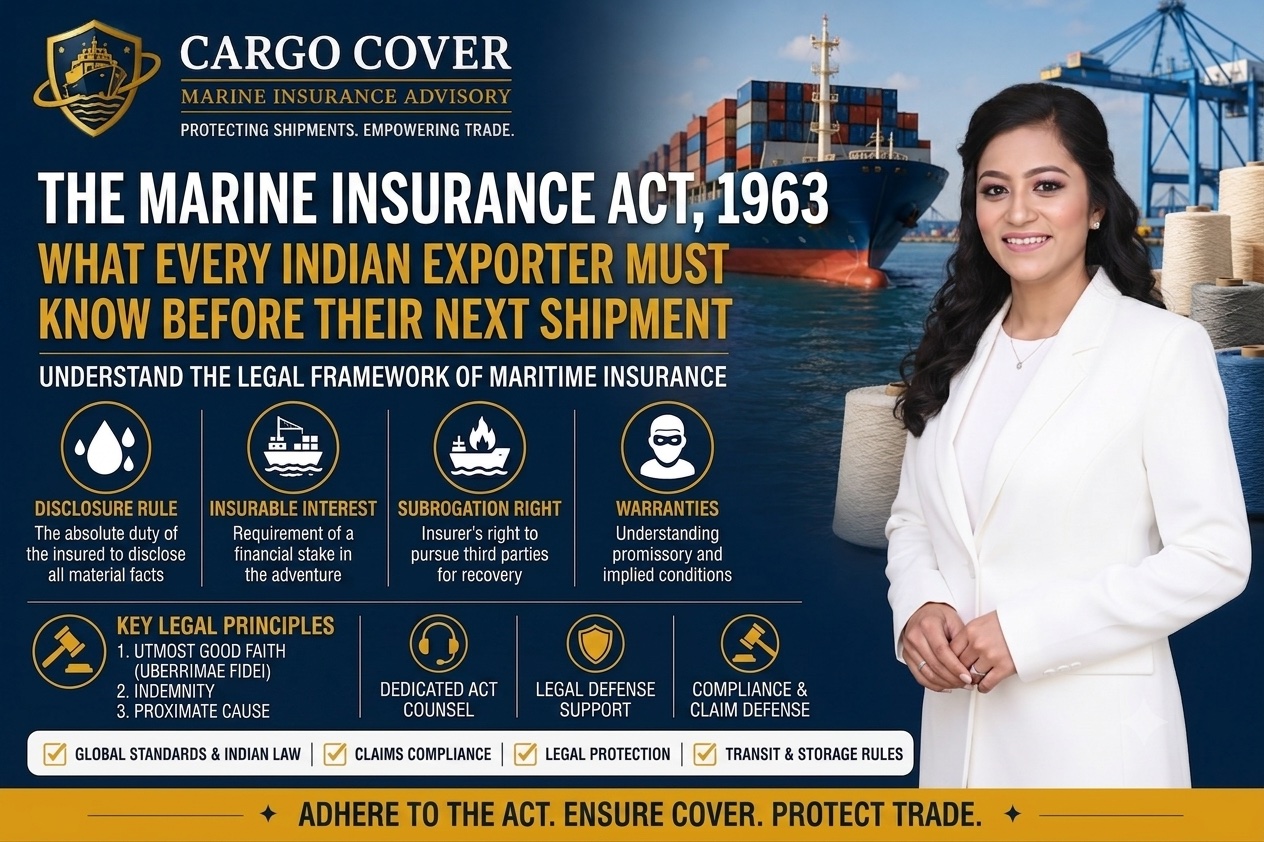
The Marine Insurance Act, 1963 — What Every Indian Exporter Must Know Before Their Next Shipment
The law behind every marine cargo policy you sign. Insurable interest, utmost good faith, warranties, and proximate cause — the four legal pillars that decide whether your claim is paid in full or rejected entirely. Cargo Cover breaks down the Marine Insurance Act, 1963 in plain language, with port-specific guidance and why an Open Policy is your strongest legal safeguard.
What Is the Marine Insurance Act, 1963 — and Why It Matters to You
The Marine Insurance Act, 1963 is India's primary legislation governing marine insurance contracts. Modelled closely on the UK Marine Insurance Act, 1906, it lays down the legal definitions, duties, and rights that apply to every cargo policy — whether covering a single container from Nhava Sheva or an entire year's shipments under an Open Policy.
For exporters, the Act is not abstract legal theory. It directly determines: whether you have the legal right to claim (insurable interest), whether your policy can be voided for non-disclosure (utmost good faith), whether a breached condition lets the insurer walk away (warranties), and whether your loss is even covered (proximate cause).
Most claim disputes in India trace back to one of these four principles being misunderstood — not to the cargo damage itself. This is exactly the gap Cargo Cover's advisory closes for exporters.
The Act — Core Concepts at a Glance
- Defines a marine insurance contract & its scope (Sec. 3)
- Establishes insurable interest as mandatory (Sec. 7–8)
- Mandates utmost good faith / full disclosure (Sec. 19–21)
- Governs warranties, express & implied (Sec. 35–45)
- Defines "proximate cause" for loss assessment (Sec. 56)
- Covers assignment, subrogation & return of premium
10 Things About the Marine Insurance Act, 1963 Every Exporter Should Know
India's most practical breakdown of the Act — translated from legal text into decisions you make every time you book a shipment from Mumbai, Mundra, Hazira, Chennai, Tuticorin or Cochin.
You Must Have "Insurable Interest"
You can only insure cargo in which you have a legal or financial stake — as owner, consignee, or under CIF/FOB terms where risk has passed to you. Insuring goods you have no stake in makes the policy void.
"Utmost Good Faith" Is a Two-Way Duty
You must disclose every material fact — cargo type, packing, route, prior losses — at the time of taking the policy. Non-disclosure, even unintentional, can let the insurer avoid the entire contract.
The Policy Must Be in Writing & Properly Worded
A marine policy must specify the subject matter, voyage/period, sum insured, and perils covered. Ambiguous wording — especially around Institute Cargo Clauses (A/B/C) — is a leading cause of disputes.
Warranties Must Be Strictly Complied With
A "warranty" in marine insurance (e.g., seaworthiness, specific route, packing standard) is not a guideline — it's a condition. Breach of warranty, even if unrelated to the actual loss, can discharge the insurer from liability.
"Proximate Cause" Decides What's Covered
The insurer is only liable for loss proximately caused by an insured peril. If the immediate cause of damage isn't covered under your policy's clauses (e.g., inherent vice, delay), the claim fails — even if a covered peril occurred earlier.
Valued vs. Unvalued Policies
A "valued policy" fixes the insured value upfront (recommended: CIF + 10%). An "unvalued policy" leaves valuation to be determined at the time of loss — often leading to disputes and under-payment.
Subrogation — The Insurer's Right of Recovery
Once your claim is paid, the insurer "steps into your shoes" to recover losses from a negligent third party (carrier, port operator). Cooperating with this process is often a policy condition.
Partial Loss vs. Total Loss — Different Rules Apply
The Act distinguishes Actual Total Loss, Constructive Total Loss, and Partial Loss — each with different notice requirements (e.g., Notice of Abandonment) and claim procedures.
Open Policies Are Fully Recognised & Encouraged
The Act and standard market practice fully support "floating" or Open Policies that auto-attach to each declared shipment — provided declarations are made promptly and in good faith.
The Law Protects You — Only If You're Advised Correctly
Every principle above can work for or against you depending on how your policy is structured and declared. This is precisely why a dedicated marine advisory desk — not a general insurance agent — is essential.
How These Legal Principles Decide Real Claim Outcomes
A quick reference on how each principle of the Marine Insurance Act, 1963 plays out in everyday export scenarios — and how Cargo Cover's advisory structures your policy to stay on the right side of each one.
| Legal Principle | Common Exporter Mistake | Typical Consequence | Cargo Cover Safeguard |
|---|---|---|---|
| Insurable Interest | Insuring goods under wrong Incoterms (risk not yet transferred) | Policy void — no valid claim | Incoterm & risk-transfer review at policy issuance |
| Utmost Good Faith | Not disclosing prior cargo damage history or packing type | Insurer avoids contract entirely | Structured disclosure checklist before binding cover |
| Warranties | Shipping via an undeclared/unapproved route | Claim discharged regardless of loss cause | Route confirmation built into declaration process |
| Proximate Cause | Assuming "All Risks" covers inherent vice or delay | Claim rejected as excluded peril | Clause-by-clause (ICC A/B/C) explanation at issuance |
| Valuation (Sec. 26–27) | Insuring only FOB value, not CIF + margin | Under-insurance — proportionate reduction in claim | CIF + 10% valuation recommended as standard |
| Open Policy Declarations | Forgetting to declare a shipment before loss occurs | Shipment treated as uninsured | Auto-declaration facility — zero missed shipments |
Serving Exporters from Every Major Port & Production Hub in India
Wherever your cargo originates and whichever port it sails from, the Marine Insurance Act, 1963 governs your policy the same way nationwide — and Cargo Cover applies the same expert rigour at every location.
Major Indian Ports We Cover
Export Cities & Production Hubs
Why an Open Policy Is the Most Legally Sound Choice Under the Act
The Marine Insurance Act, 1963 places real weight on disclosure, declaration, and good faith. Under a Specific Shipment Policy, every single booking is a fresh contract — meaning every disclosure, valuation, and declaration must be correct, every time, with no margin for error.
An Open Marine Policy with Cargo Cover restructures this entirely. The legal framework (insurable interest, good faith, valuation basis) is established once, correctly, at the outset — and every subsequent shipment is auto-declared under those agreed terms via our auto-declaration facility, satisfying the Act's declaration requirements automatically.
The result: fewer points of legal failure, faster claims processing, and complete door-to-door cover from your factory in Tirupur, Ludhiana or Surat to the final destination — anywhere in the world.
Open Policy vs. Specific Policy — Legal Compliance
| Compliance Factor | Open Policy | Specific Policy |
|---|---|---|
| Disclosure Required Per Shipment | Once, at policy issuance | Every shipment |
| Risk of Missed Declaration (Sec. compliance) | Eliminated — auto-declared | High during peak season |
| Valuation Basis Consistency | Standardised upfront | Re-negotiated each time |
| Admin Effort | Minimal | High |
| Best For | Regular exporters | One-off shipments |
India's Most Specialist Marine Insurance Advisory — One Job, Done Right
We don't sell motor, health, or general insurance on the side. Understanding the Marine Insurance Act, 1963 and applying it correctly to your shipments is the only thing we do, every day, for exporters across India.
Specialist Marine-Only Expertise
A dedicated desk that understands the Marine Insurance Act, 1963 inside out — and applies it to every policy we structure.
2-Hour Surveyor Activation
Pre-registered surveyor network at destination ports means rapid incident response — when every hour counts toward a clean claim.
Open Policy Auto-Declaration
Every shipment auto-covered and auto-declared, satisfying the Act's good-faith and declaration requirements without manual effort.
50+ Insurer Partnerships
Backed by ICICI Lombard and a wide insurer network — competitive premiums without compromising legal protection.
Complete Documentation Support
From correct policy wording to claims paperwork, our team manages documentation end-to-end — minimising legal exposure.
Worldwide, Door-to-Door Coverage
From factory floor in Tirupur or Ludhiana to final destination anywhere in the world — one continuous, legally sound cover.
Claims Support Until Settlement
We stay engaged through the entire claims lifecycle — including subrogation and recovery processes — not just policy issuance.
Valuation & Disclosure Review
Every policy reviewed for correct insurable interest, valuation basis, and disclosure — before you ever need to make a claim.
1000+ Happy Exporter Clients
Trusted across 100+ destination countries — from first-time exporters to large-scale annual shippers.
Don't Let a

Search
Recent Posts
- Open Marine Insurance Policy Marine Cargo Insurance | Annual Cover
- Annual Open Marine Insurance Policy India Guide
- Open Policy vs Floating Policy in Marine Insurance: Are They the Same?
- General Insurance Agent vs Marine Cargo Specialist
- National & Specialized Indian Brokers: Where Cargo Cover Advisory Fits


Leave a Comment