cargocoverindia@gmail.com - GST NO. : 23ASHPA0569P1ZM
- Send Email


Posted by Admin on July, 04, 2026
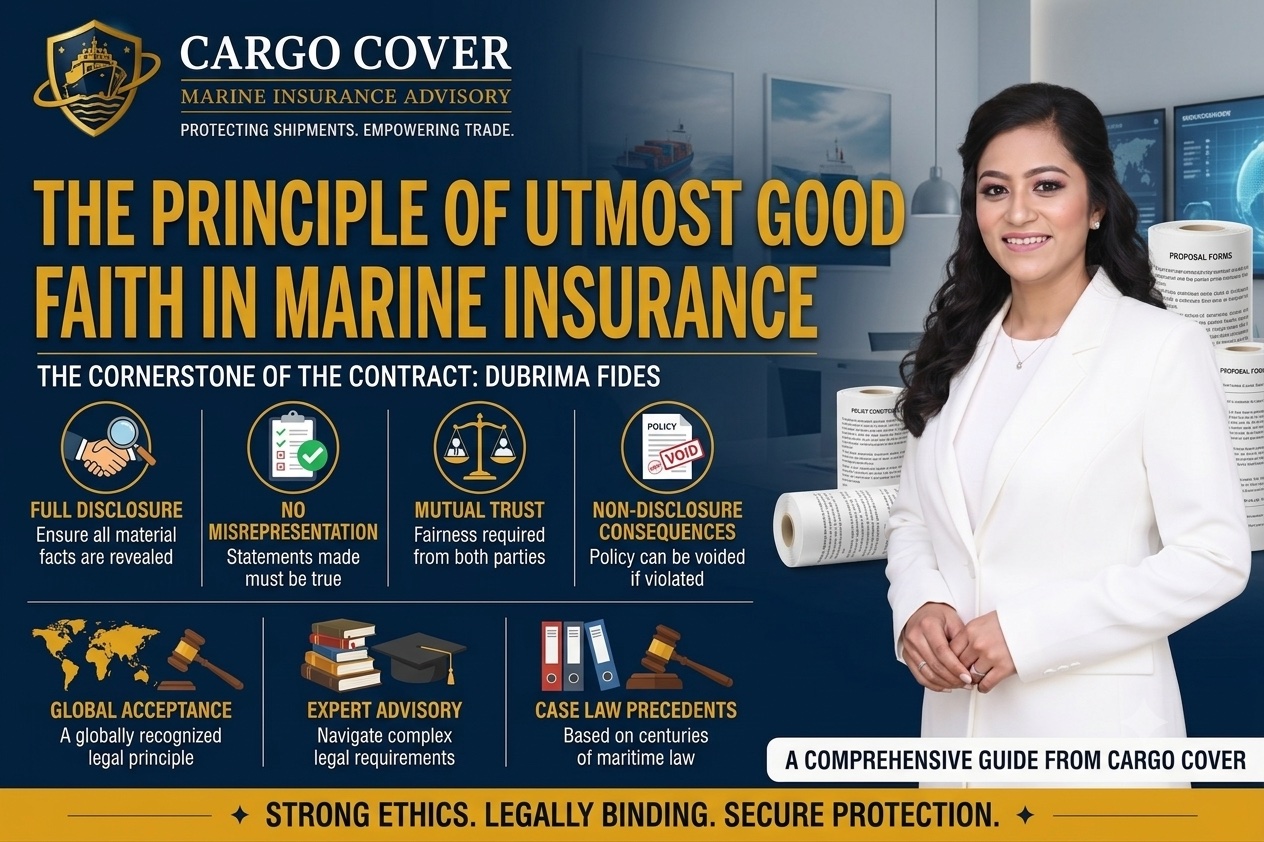
What This Guide Covers
Utmost Good Faith is the most misunderstood — and most dangerous — principle in marine insurance for Indian exporters. This guide explains it completely, practically, and with real consequences so you never accidentally void your policy.
What Is Utmost Good Faith in Marine Insurance?
Utmost Good Faith — in Latin, Uberrimae Fidei — is the foundational legal principle on which all marine insurance contracts are built. It is not a best practice or a recommendation. It is a binding legal obligation on both the insured and the insurer, enshrined in the Marine Insurance Act, 1963, and enforced by Indian courts.
In simple terms, it means this: when you apply for a marine cargo policy, you must tell the insurer everything that is material to the risk — fully, accurately, and voluntarily — even if they do not ask. The insurer, in turn, must tell you everything that is material to your decision to take the policy — all exclusions, all conditions, all limitations. Neither party can conceal, misrepresent, or remain silent about anything that would change the other party's decision.
Why Marine Insurance Demands More Than Ordinary Good Faith
In most commercial contracts, you are only required to answer questions honestly — you have no duty to volunteer information. Marine insurance is fundamentally different. When a Surat diamond exporter applies for a marine policy, the insurer cannot inspect the diamonds, cannot visit the packing facility, cannot assess the routing risk personally. The insurer relies entirely on the information provided by the exporter. If that information is incomplete or incorrect — even innocently — the entire basis of the contract is undermined.
This is why marine insurance law requires not just ordinary honesty, but utmost good faith — a proactive, complete, and voluntary disclosure of all facts that could affect the insurer's assessment of the risk and the premium charged.
The Marine Insurance Act, 1963 — India's Governing Law on Utmost Good Faith
Unlike general insurance in India (governed by the Insurance Act, 1938), marine cargo insurance is specifically governed by the Marine Insurance Act, 1963 — which closely follows the UK Marine Insurance Act, 1906, one of the most influential insurance statutes in the world. The key sections every Indian exporter must know:
Disclosure and Utmost Good Faith — The Core Obligation
"A contract of marine insurance is a contract based upon the utmost good faith, and, if the utmost good faith be not observed by either party, the contract may be avoided by the other party." This is the master provision — establishing that the entire marine insurance contract is premised on complete mutual disclosure. Breach by either party entitles the other to avoid (void) the contract.
Disclosure by the Insured — What Must Be Revealed
"Subject to the provisions of this section, the assured must disclose to the insurer, before the contract is concluded, every material circumstance which is known to the assured, and the assured is deemed to know every circumstance which, in the ordinary course of business, ought to be known by him." The key phrase: every material circumstance — including those the exporter ought to know, not just those they actually know. Ignorance is not a complete defence.
What Is Material — The Test
"Every circumstance is material which would influence the judgment of a prudent insurer in fixing the premium, or determining whether he will take the risk." The test is not whether the insurer asked about the fact — it is whether a prudent insurer would have wanted to know it. If the answer is yes, the fact is material and must be disclosed, whether asked or not.
Disclosure by the Insurer — The Mutual Obligation
The insurer must disclose to the insured every material circumstance known to the insurer which the insured would not be reasonably expected to know — including any unusual policy exclusions, conditions precedent, or claims requirements that a reasonable insured might not anticipate. This is why working with a specialist advisor like Cargo Cover — who explains every term, every exclusion, every condition — is so important.
Warranty — Absolute Compliance Required
Marine insurance policies often contain express and implied warranties — specific factual statements that are guaranteed to be true. A warranty, once breached, automatically discharges the insurer from liability from the date of breach — regardless of whether the breach caused the loss. This makes warranty compliance a critical element of ongoing good faith throughout the policy period, not just at inception.
📖 IRDAI's Role: While the Marine Insurance Act, 1963 governs the contract law of marine insurance, the Insurance Regulatory and Development Authority of India (IRDAI) oversees the conduct of insurers in applying these provisions. ICICI Lombard, as an IRDAI-regulated insurer, applies these provisions consistently — and Cargo Cover's advisory service ensures every client's disclosures fully comply with both the Marine Insurance Act and IRDAI guidelines.
What Is a "Material Fact" in Marine Insurance?
The entire doctrine of Utmost Good Faith turns on the concept of a material fact. The legal test — from Section 20(2) of the Marine Insurance Act — is straightforward: a fact is material if it would influence the judgment of a prudent insurer in deciding whether to accept the risk, and at what premium.
This test is objective, not subjective. It does not matter whether the exporter thought the fact was important. It does not matter whether the insurer's online form asked about it. What matters is: would a prudent marine underwriter at ICICI Lombard have wanted to know this before issuing the policy? If yes — it must be disclosed.
Nature of the Cargo
What the goods actually are — not just the commercial description on the invoice. Hazardous chemicals described as "industrial goods," fragile goods described as "general merchandise," or high-value electronics described as "electrical components" are all material misrepresentations.
True Commercial Value
The actual market value of the cargo — not an artificially deflated value to reduce premium. Under-stating cargo value is both a breach of Utmost Good Faith and a ground for proportional under-settlement under the principle of average.
Complete Voyage Route
Every port of call, every transshipment point, and every routing variation must be disclosed. A shipment transiting Jebel Ali or Colombo carries a different risk profile from a direct voyage. Conflict-zone routing — Red Sea, Strait of Hormuz — is highly material.
Vessel Quality & Age
If the exporter knows the vessel is old, unseaworthy, or has a poor inspection record, this is material. Shipping on a sub-standard vessel without disclosing known vessel quality concerns is a breach of Utmost Good Faith.
Prior Claims History
Previous marine cargo claims — with any insurer, on any policy — within the last 3–5 years are material facts. An exporter with three prior total loss claims is a fundamentally different risk from a first-time insured. Non-disclosure of prior claims is one of the most litigated breach scenarios in Indian marine insurance.
Hazardous Properties of Cargo
If cargo has flammable, explosive, corrosive, or reactive properties — even if the primary description is non-hazardous — this must be disclosed. Chemical exporters from Bharuch shipping dual-nature goods, or pharma exporters shipping temperature-sensitive biologics, must ensure full hazard disclosure.
Packaging Method & Standard
Fragile cargo packed in non-standard packaging, goods exceeding standard weight limits packed without reinforcement, or any packaging that falls below industry norms for the commodity — all of these are material to the insurer's risk assessment and must be disclosed.
Seasonal & Environmental Risks
Shipping during monsoon season on routes known to have adverse weather, shipping perishables during extreme temperature seasons, or shipping through areas known to have elevated theft rates — all of these seasonal and environmental risk factors are material.
Special Storage or Handling Requirements
If cargo requires temperature control, humidity control, upright storage, or any other special handling — and the exporter knows this but does not disclose it when arranging the policy — this is a material non-disclosure, particularly for pharmaceutical cold chain and seafood exports.
What You Must Disclose — What You Need Not — What Constitutes Breach
Indian exporters often struggle with the boundary between what they must disclose and what is outside the scope of the duty. The following framework — based on the Marine Insurance Act, 1963 and established Indian insurance law — provides clear practical guidance.
✅ MUST Disclose — Always
- True nature and description of cargo
- Accurate CIF value at time of shipment
- Full voyage route — including all transshipment ports
- Known vessel name, age, and flag state (if known)
- Any hazardous or dangerous properties of cargo
- Prior marine cargo claims — last 3–5 years, all insurers
- Packaging method — especially for fragile or heavy goods
- Any known special handling or storage requirements
- Seasonal risks relevant to the voyage timing
- Conflict zone routing — Red Sea, Strait of Hormuz, etc.
- Any previous policy voidances or claim rejections
- Any known survey defects from pre-shipment inspection
⚠️ NEED NOT Disclose — These Are Exceptions
- Facts that are of common knowledge in the trade
- Facts the insurer already knows from their own records
- Facts that are irrelevant to the risk being insured
- Facts that lessen the risk (not more material = not required)
- Facts that the insurer waived disclosure of (by not asking when they ought to have)
- Facts the exporter could not reasonably have known at inception
- Facts made irrelevant by a specific policy warranty
❌ BREACH — Policy Can Be Voided
- Describing hazardous chemicals as "general cargo"
- Under-declaring cargo value to save premium
- Concealing prior claims history from any insurer
- Not disclosing Red Sea / conflict zone routing
- Omitting transshipment ports from voyage description
- Describing sub-standard packaging as standard
- Concealing pre-shipment damage or survey defects
- Misrepresenting commodity type (e.g., saying "textiles" for electronics)
- Not disclosing known vessel quality concerns
- Failure to disclose seasonal voyage risks
⚠️ The "I Didn't Know" Defence Is Limited: Under Section 20 of the Marine Insurance Act, 1963, an exporter is deemed to know every circumstance which, in the ordinary course of business, ought to be known by him. This means an experienced Ahmedabad pharmaceutical exporter who "didn't know" that their cold-chain cargo required temperature disclosure, or an experienced Surat gem exporter who "didn't know" that transshipment at Jebel Ali was a material route fact — will not succeed with an ignorance defence. Professional knowledge imposes professional disclosure responsibility.
Non-Disclosure vs Misrepresentation — Understanding the Difference
Both non-disclosure and misrepresentation breach Utmost Good Faith — but they arise differently and carry different legal implications. Every Indian exporter must understand the distinction.
📵 Non-Disclosure — Silence That Misleads
What it is: Failing to volunteer a material fact that the exporter knows (or ought to know) — even if the insurer did not specifically ask.
Example: A Rajkot engineering exporter does not mention that their previous policy with another insurer was voided due to a fraudulent claim. The new insurer does not ask. The non-disclosure is innocent — but it is still a breach.
Consequence: Insurer may void the policy from inception. All claims rejected. No legal obligation to return premium in cases of fraudulent non-disclosure.
📝 Misrepresentation — A Statement That Is Wrong
What it is: Actively stating an incorrect fact when completing the proposal form or providing information to the insurer — whether intentionally (fraudulent) or by mistake (innocent).
Example: A Bharuch chemical exporter describes a corrosive industrial chemical as "non-hazardous general merchandise" on the insurance proposal. This is an active misrepresentation — not mere silence.
Consequence: Insurer may void the policy. Fraudulent misrepresentation additionally exposes the exporter to criminal liability under the Indian Penal Code.
| Factor | Non-Disclosure | Innocent Misrepresentation | Fraudulent Misrepresentation |
|---|---|---|---|
| Definition | Failure to volunteer a material fact | Incorrect statement — honestly believed true | Deliberate false statement to deceive |
| Intent Required? | No — silence alone suffices | No — honest mistake counts | Yes — deliberate deception |
| Policy Voidable? | Yes | Yes | Yes — and more |
| Claims Rejected? | All claims — yes | All claims — yes | All claims — yes |
| Premium Returned? | May be returned | Usually returned | Not returned — forfeited |
| Criminal Exposure? | No | No | Yes — IPC provisions apply |
| Future Insurability? | May be flagged | Usually not flagged | Blacklisted — difficult to insure |
The Insurer's Duty of Utmost Good Faith — What ICICI Lombard Must Disclose to You
Utmost Good Faith is not a one-way obligation. The insurer — ICICI Lombard in the case of Cargo Cover clients — also bears a duty to disclose all material facts that could affect the exporter's decision to enter the contract. This includes:
All Policy Exclusions — Clearly Explained
Every exclusion from the ICC clause — War Risk, SRCC, inherent vice, delay, insolvency of carrier — must be clearly disclosed and explained. An insurer who issues an ICC (B) policy without
Search
Recent Posts
- Consequential Loss / Delay in Start-Up (DSU) — Marine Cargo Add-On Cover | CargoCover Advisory
- Concealed Damage / 90-Days Discovery Clause — Marine Cargo Add-On Cover | CargoCover Advisory
- Jettison & Washing Overboard Clause — Marine Cargo Add-On Cover | CargoCover Advisory
- Spontaneous Combustion Cover — Marine Cargo Add-On Cover | CargoCover Advisory
- Leakage & Breakage Cover — Marine Cargo Add-On Cover | CargoCover Advisory


Leave a Comment