cargocoverindia@gmail.com - GST NO. : 23ASHPA0569P1ZM
- Send Email


Posted by Admin on July, 04, 2026
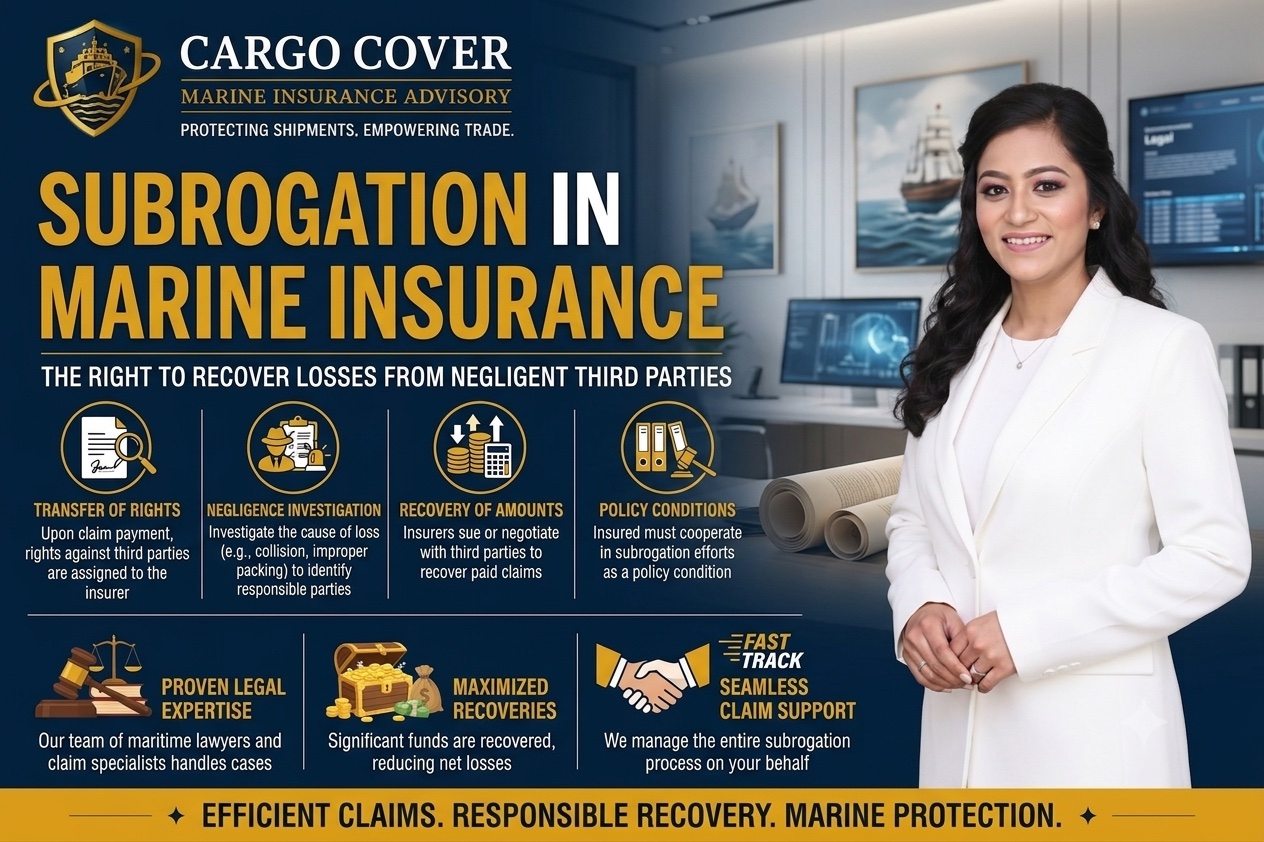
What Is Subrogation in Marine Insurance? A Simple Explanation Every Exporter Should Know
Your claim gets paid — but the story doesn't end there. Subrogation is the insurer's legal right to recover that payout from whoever actually caused the damage — a careless carrier, a negligent port operator, or a third party. Most exporters have never heard the word, yet it can directly affect how fast and how fully their claim is settled. Cargo Cover explains it in plain English — and shows why an Open Policy keeps you protected either way.
Subrogation = "The Insurer Steps Into Your Shoes"
Imagine your export consignment is damaged because a shipping line's crane operator drops a container during loading at JNPT. Your cargo policy pays out your claim promptly — that's the whole point of insurance: you get made whole quickly, without waiting for a blame game to be resolved.
But someone was at fault — the terminal operator. Subrogation gives your insurer the legal right to step into your position and pursue that terminal operator for the amount they paid you. You've already been compensated, so this recovery effort is now the insurer's business, not yours.
This single principle — recognised under the Marine Insurance Act, 1963 and standard market practice — is what allows insurers to settle claims quickly while still holding negligent parties accountable in the background.
Think of a car accident where the other driver was clearly at fault. Your own insurer pays for your car's repair immediately — so you're not stuck without a vehicle — and then your insurer separately goes after the at-fault driver's insurer to recover that cost. You don't have to fight that battle. Marine cargo subrogation works on exactly the same principle, just with containers, carriers, and ports instead of cars and drivers.
How Subrogation Actually Plays Out — From Loss to Recovery
A simplified walkthrough of what happens behind the scenes after your cargo is damaged and your claim is paid.
Loss Occurs
Cargo is damaged in transit — e.g., mishandling at a port, or a carrier's negligence during ocean transit.
You File a Claim
You notify your insurer, submit documents, and Cargo Cover coordinates the surveyor assessment.
Insurer Pays You
Your insurer settles the claim based on your policy terms — without waiting to establish who's at fault.
Subrogation Rights Transfer
By accepting payment, your right to claim against the negligent third party transfers to the insurer.
Insurer Pursues Recovery
The insurer (or their legal team) pursues the carrier, port operator, or other liable party for recovery.
10 Things Every Exporter Should Know About Subrogation
Practical points that affect how smoothly your claims are settled — drawn from real cases across Mumbai (JNPT/Nhava Sheva), Mundra, Hazira, Chennai, Tuticorin and Cochin.
Subrogation Doesn't Delay Your Payout
Your claim is settled based on policy terms — the recovery process against the responsible party happens afterward and separately, and never holds up your payment.
You Must Not "Settle" With the Third Party Yourself
If you independently accept compensation or sign a release with a carrier/port operator before or after your claim, you may unknowingly waive the insurer's subrogation rights — and your insurer may reduce or deny your claim as a result.
Cooperation Is Often a Policy Condition
Most policies require you to assist the insurer's recovery efforts — providing documents, statements, or signatures — even after your claim is paid.
It Helps Keep Premiums Competitive Industry-Wide
When insurers successfully recover from negligent carriers and operators, it reduces overall claims costs — which helps keep marine premiums affordable for all exporters.
Bill of Lading Clauses Matter
Carrier liability limitations in your Bill of Lading directly affect how much an insurer can recover via subrogation — and indirectly, how insurers price risk on certain routes.
Time Limits Apply
Carriers and port operators have statutory time limits for claims (e.g., under the Carriage of Goods by Sea Act / Hague-Visby Rules). Delayed reporting can weaken the insurer's recovery — and your future claims history.
Subrogation Applies to Both Open & Specific Policies
The principle is the same regardless of policy type — but an Open Policy's standardised documentation makes the recovery process smoother and faster.
Good Documentation = Stronger Recovery
Photos, surveyor reports, weighment slips, and handover receipts at every stage strengthen both your claim and the insurer's subsequent recovery case.
It Doesn't Cost You Anything Extra
Subrogation is a standard right embedded in your policy — there's no additional fee, and it works entirely in the background after your claim is settled.
The Right Advisory Desk Protects Both Sides
Cargo Cover ensures your claim documentation is structured so that you're paid quickly and the insurer's recovery rights remain fully intact — protecting your long-term relationship with insurers and premium rates.
Subrogation in Action — Common Export Scenarios
A quick reference on how subrogation typically applies in everyday cargo-loss situations Indian exporters encounter.
| Loss Scenario | Likely Negligent Party | Your Action | Insurer's Subrogation Action |
|---|---|---|---|
| Container dropped during loading at port | Port terminal operator / stevedore | File claim with surveyor report | Recovery action against terminal operator |
| Water damage due to improper stowage on vessel | Shipping line / vessel operator | File claim with photos & survey | Recovery action against carrier under Bill of Lading |
| Damage during inland transit (truck accident) | Transporter / logistics provider | File claim with police report & survey | Recovery action against transporter's insurer |
| Loss due to inherent vice (cargo's own nature) | No third party — not a covered event typically | Standard claim process applies | No subrogation — not applicable |
| Theft from CFS/warehouse before loading | Warehouse operator / CFS | File claim with FIR & documentation | Recovery action against warehouse/CFS operator |
Serving Exporters from Every Major Port & Production Hub in India
Wherever your cargo loss occurs — at port, on vessel, or inland — Cargo Cover ensures your claim is filed correctly and your insurer's subrogation rights remain protected, nationwide.
Major Indian Ports We Cover
Export Cities & Production Hubs
Why an Open Policy Makes Subrogation Work For You
Subrogation depends entirely on clean documentation — handover receipts, survey reports, Bill of Lading clauses, and timely loss notification. Under a Specific Shipment Policy, this documentation trail is rebuilt from scratch for every booking, and gaps are common — especially during busy export seasons.
An Open Marine Policy with Cargo Cover standardises this entire process. Every shipment is auto-declared under consistent terms, with the same documentation framework applied every time — so when a loss does occur, both your claim and your insurer's subrogation recovery are built on a clean, consistent paper trail.
The result: faster claim settlements, stronger recovery outcomes for insurers (which helps your future premiums), and complete door-to-door cover from your factory in Tirupur, Ludhiana or Surat to the final destination — anywhere in the world.
Open Policy vs. Specific Policy — Documentation & Recovery
| Factor | Open Policy | Specific Policy |
|---|---|---|
| Documentation Consistency | Standardised across all shipments | Rebuilt every shipment |
| Claim Filing Speed | Faster — known framework | Slower — case-by-case |
| Subrogation Recovery Strength | Stronger — clean paper trail | Variable |
| Admin Effort | Minimal | High |
| Best For | Regular exporters | One-off shipments |
India's Most Specialist Marine Insurance Advisory — One Job, Done Right
We don't sell motor, health, or general insurance on the side. Understanding the fine print — including subrogation — and structuring your policy and claims around it is the only thing we do, every day, for exporters across India.
Specialist Marine-Only Expertise
A dedicated desk that understands subrogation, recovery processes, and how to document claims for both speed and strength.
2-Hour Surveyor Activation
Pre-registered surveyor network at destination ports means rapid, well-documented incident response — vital for clean claims and recoveries.
Open Policy Auto-Declaration
Every shipment auto-covered and auto-declared, building a consistent documentation trail for every consignment.
50+ Insurer Partnerships
Backed by ICICI Lombard and a wide insurer network — competitive premiums and efficient claims-and-recovery coordination.
Complete Documentation Support
From handover receipts to survey reports, our team ensures your paperwork supports both your claim and the insurer's recovery process.
Worldwide, Door-to-Door Coverage
From factory floor in Tirupur or Ludhiana to final destination anywhere in the world — one continuous, well-documented cover.
Search
Recent Posts
- Consequential Loss / Delay in Start-Up (DSU) — Marine Cargo Add-On Cover | CargoCover Advisory
- Concealed Damage / 90-Days Discovery Clause — Marine Cargo Add-On Cover | CargoCover Advisory
- Jettison & Washing Overboard Clause — Marine Cargo Add-On Cover | CargoCover Advisory
- Spontaneous Combustion Cover — Marine Cargo Add-On Cover | CargoCover Advisory
- Leakage & Breakage Cover — Marine Cargo Add-On Cover | CargoCover Advisory


Raise your Query
Hi! Simply click below and type your query.
Our experts will reply you very soon.
Leave a Comment