cargocoverindia@gmail.com - GST NO. : 23ASHPA0569P1ZM
- Send Email


Posted by Admin on July, 04, 2026
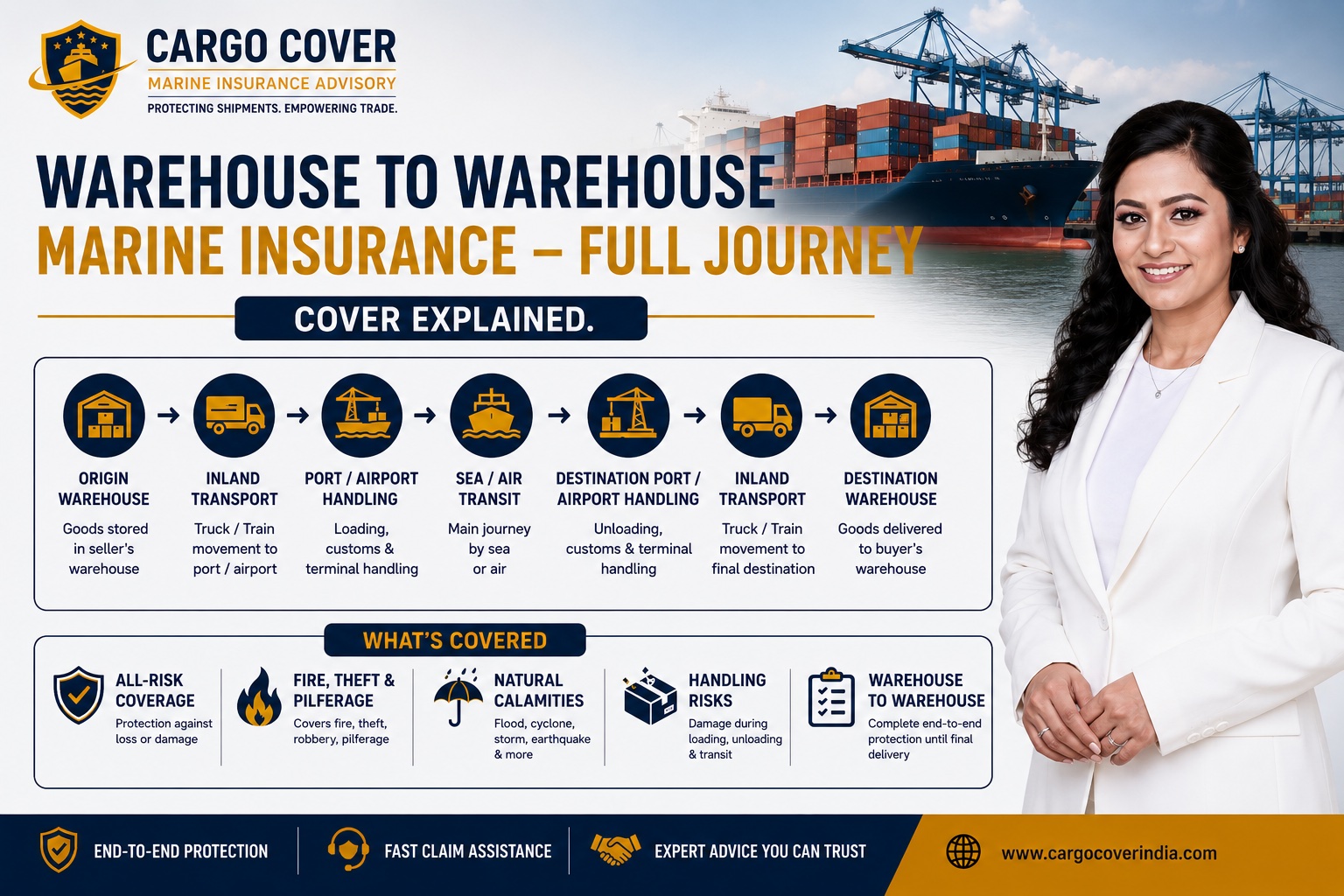
Warehouse to Warehouse Marine Insurance — Complete Index
This is India's most detailed guide to warehouse-to-warehouse marine cargo insurance — written specifically for Indian exporters, CHAs, freight forwarders, and logistics professionals. Each section is explained with what is covered, what the gaps are, which Indian exporters are most at risk, and real INR and USD claim scenarios.
What Is Warehouse-to-Warehouse Marine Insurance?
Warehouse-to-warehouse marine insurance is a full-journey cargo policy that covers your goods from the moment they leave your factory or warehouse until they are delivered into the buyer's warehouse at the destination — including every mode of transport, every port, every terminal, every transshipment hub, and every border crossing in between.
It is governed by the Institute Cargo Clauses (ICC) Transit Clause — the internationally accepted legal framework for marine cargo insurance, published by the Institute of London Underwriters and adopted by all major Indian insurers including ICICI Lombard. The Transit Clause defines precisely when cover commences, when it terminates, and what happens in between.
⚠️ The Critical Misunderstanding: Most Indian exporters assume their marine policy automatically covers the complete door-to-door journey. This is not always true. Many Indian marine policies have subtle wording that commences cover only at the port of loading gate — leaving the inland truck journey from factory to port completely uninsured. Some policies also exclude the final truck delivery from the destination port to the buyer's warehouse. These gaps have cost Indian exporters crores in unrecovered losses. Cargo Cover closes every gap before your policy is issued.
The Three Types of Marine Policy Wordings — And Why They Differ
Properly Worded W2W Policy
Commences at the named factory or warehouse address. Covers all inland transit, port operations, sea voyage, destination port, and delivery to buyer's warehouse. This is what every exporter should have — and what Cargo Cover issues as standard.
Port-Commencement Policy
Commences at the port of loading gate or Container Freight Station (CFS). The inland truck journey from factory to port is NOT covered. If the truck is in an accident on NH-48 between Rajkot and Mundra, the loss is uninsured.
Vessel-Only Policy
Commences only when the goods are actually loaded onto the ocean vessel. Port operations, CFS storage, and all inland movements are excluded. Sometimes issued as a cost-cutting measure — represents a dangerously false economy for any exporter with inland exposure.
The ICC Transit Clause — Exact Language & What It Means
The Institute Cargo Clauses Transit Clause (Clause 8 in ICC A/B/C) contains the legally binding definition of when your warehouse-to-warehouse cover begins and ends. Here is the exact language — and what every word means for Indian exporters.
📜 ICC Clause 8.1 (Commencement): "Subject to the provisions of Clause 11, this insurance attaches from the time the subject-matter insured is first moved in the warehouse or at the place of storage (at the place named in the contract of insurance) for the purpose of the immediate loading into or onto the carrying vehicle or other conveyance for the commencement of transit..."
📜 ICC Clause 8.1 (Termination): "...and continues during the ordinary course of transit and terminates either: (i) on completion of unloading from the carrying vehicle or other conveyance in or at the final warehouse or place of storage at the destination named herein; (ii) on completion of unloading from the carrying vehicle or other conveyance in or at any other warehouse or place of storage, whether prior to or at the destination named herein, which the Assured elect to use either for storage other than in the ordinary course of transit or for allocation or distribution; or (iii) on the expiry of 60 days after completion of discharge overside of the subject-matter insured from the oversea vessel at the final port of discharge, whichever shall first occur."
Plain-Language Translation for Indian Exporters
| ICC Clause Term | Plain Meaning for Indian Exporter | Risk if Misunderstood |
|---|---|---|
| "First moved in the warehouse" | Cover begins when the goods are physically first moved/lifted from your factory floor or warehouse storage for loading | If policy says "port commencement" instead, this language does not apply — gap exists |
| "For the purpose of immediate loading" | The movement must be for the purpose of sending the goods on their journey — not just rearranging storage | Moving goods within warehouse for internal storage does not trigger cover |
| "During the ordinary course of transit" | Cover continues as long as goods are moving through the normal shipping route — any unreasonable deviation may suspend cover | Routing change without insurer notification can void the policy |
| "Final warehouse at the destination" | Cover ends when goods arrive at the buyer's actual warehouse — not at the port, not at a CFS, not at an importer's agent's location | If buyer diverts goods to an intermediate location, cover may terminate early |
| "60 days after discharge" | If the goods are not delivered to the buyer's warehouse within 60 days of being discharged from the ocean vessel, cover automatically expires | Customs delays, port congestion, and buyer payment disputes can easily exceed 60 days |
| "Any other warehouse used for storage other than ordinary transit" | If the buyer holds goods in a bonded warehouse for redistribution — not just temporary transit storage — cover may terminate at that point | Buyers who use distribution centres before final delivery may inadvertently terminate cover |

Search
Recent Posts
- Consequential Loss / Delay in Start-Up (DSU) — Marine Cargo Add-On Cover | CargoCover Advisory
- Concealed Damage / 90-Days Discovery Clause — Marine Cargo Add-On Cover | CargoCover Advisory
- Jettison & Washing Overboard Clause — Marine Cargo Add-On Cover | CargoCover Advisory
- Spontaneous Combustion Cover — Marine Cargo Add-On Cover | CargoCover Advisory
- Leakage & Breakage Cover — Marine Cargo Add-On Cover | CargoCover Advisory


Leave a Comment