cargocoverindia@gmail.com - GST NO. : 23ASHPA0569P1ZM
- Send Email


Posted by Admin on July, 04, 2026
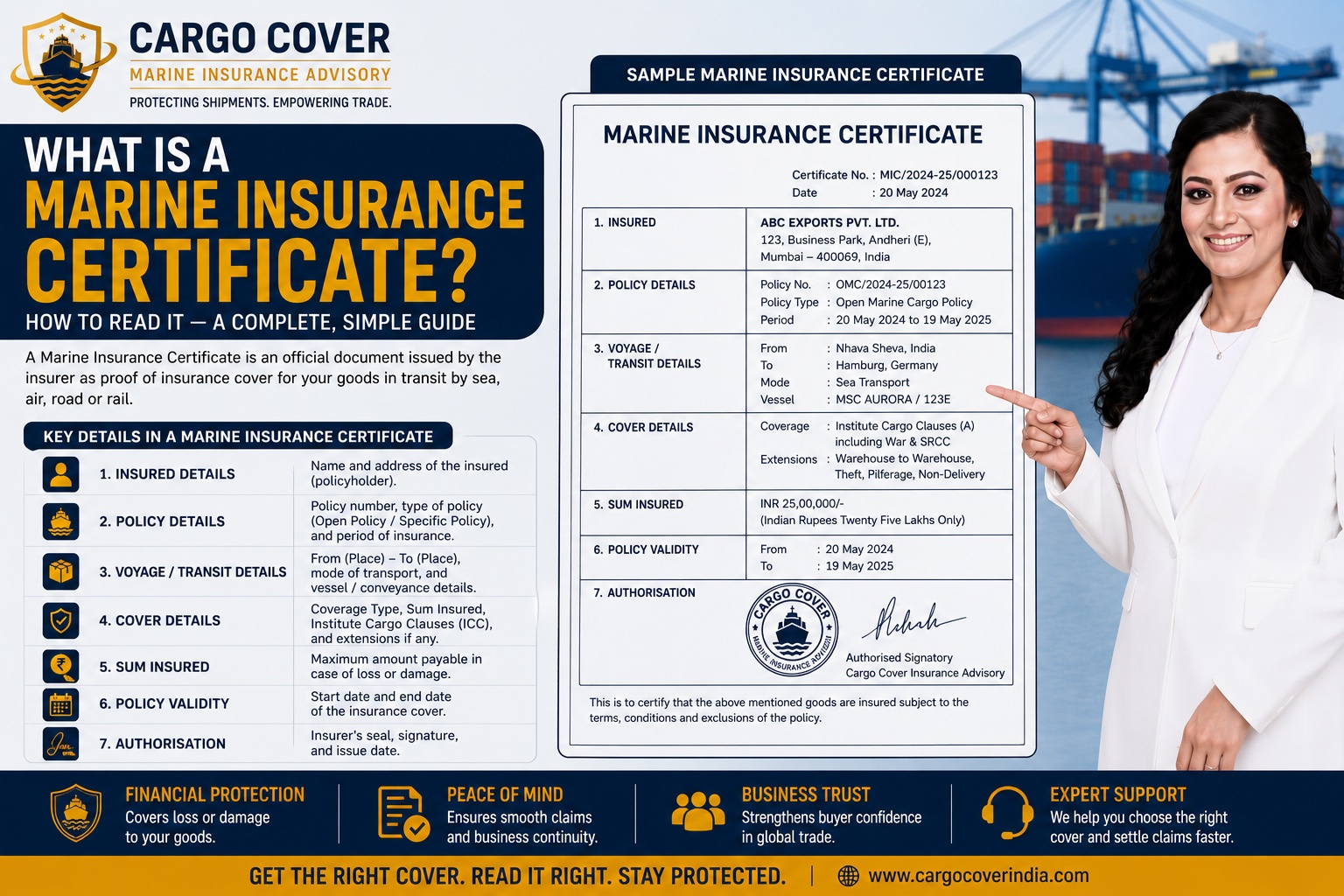
What Is a Marine Insurance Certificate? How to Read It — A Complete, Simple Guide
You've received your insurance certificate — a dense, official-looking document full of codes, clauses, and numbers. But what does it actually say about your cargo's protection? Cargo Cover breaks down every field, line by line, in plain English — so you know exactly what you're covered for, before you ever need to make a claim.
A Marine Insurance Certificate = Your "Proof of Cover" Document
A marine insurance certificate is a short-form document issued by an insurer (or under an Open Policy, generated against your master policy) confirming that a specific shipment is covered — what risks are insured, for how much, and under which terms.
It serves multiple purposes: it's part of your export document set for banks under a Letter of Credit, it's the document your buyer or consignee may need if a claim arises at destination, and it's your own quick-reference record of exactly what protection your cargo has during transit.
Most exporters glance at it, confirm it "looks official," and move on — without checking whether the details actually match their shipment. This guide changes that.
Think of a marine insurance certificate like a boarding pass for your cargo. It doesn't explain the airline's entire policy — but it tells you the essentials: who is travelling (the cargo and assured party), where it's going (voyage details), how much it's worth (insured value), and what class of protection it has (the risk clauses). If any of these details are wrong, the "boarding pass" won't work when you need it.
Reading a Marine Insurance Certificate — An Annotated Example
A simplified, sample layout showing the key fields found on most marine insurance certificates issued in India — and what each one means for you as an exporter.
10 Things to Check on Every Certificate Before You Rely On It
Practical checks that take two minutes but can save weeks of dispute — drawn from real cases across Mumbai (JNPT/Nhava Sheva), Mundra, Hazira, Chennai, Tuticorin and Cochin.
Is the "Assured" Party Correct?
Check that your company name is spelled correctly and matches your invoice and LC requirements — incorrect names can complicate both claims and bank acceptance.
Does the Sum Insured Match CIF + Margin?
Confirm the insured value reflects your CIF value plus the agreed margin (commonly +10%) — under-insurance can lead to proportionate reduction in any claim.
Do Vessel & Port Details Match Your B/L?
Vessel name, voyage number, port of loading and discharge should be consistent across your certificate, Bill of Lading, and invoice.
What Do the "Institute Cargo Clauses" Actually Cover?
ICC (A) is broad "All Risks" cover; ICC (B) and (C) are progressively narrower. Know which one is on your certificate — it determines what's covered if something goes wrong.
Are War & Strikes Clauses Included — or Excluded?
If your route passes through higher-risk zones, confirm whether War Risk and SRCC clauses are listed as included, or whether they need to be added separately.
Does the Goods Description Match Your Invoice?
A mismatched or vague cargo description can raise questions during both LC document checks and claims processing.
Is the Certificate Dated Correctly Relative to Shipment?
For LC purposes, the certificate date generally should not be later than the Bill of Lading date — check this before presenting documents to your bank.
Do You Know Who to Call If Something Goes Wrong?
Save the claims/survey contact details from your certificate — in a real emergency, you don't want to be searching for this information.
Is the Insured Value in the Right Currency?
Especially important under LCs — the currency of the insured value should typically match the currency of the credit/invoice.
Under an Open Policy, Every Certificate Follows the Same Format
With Cargo Cover's Open Policy, you learn the format once — every subsequent certificate follows the same structure, making it easy to spot-check in seconds.
ICC (A), (B), (C) & Add-Ons — What Your Certificate's Clauses Mean
A quick reference for the most common risk clauses you'll see listed on a marine insurance certificate.
| Clause | Coverage Level | What It Generally Covers | Common Use Case |
|---|---|---|---|
| Institute Cargo Clauses (A) | Broadest — "All Risks" | Loss or damage from any cause, except specific exclusions (e.g., inherent vice, willful misconduct, war/strikes unless added) | Recommended default for most general cargo exports |
| Institute Cargo Clauses (B) | Moderate | Named perils — fire, explosion, vessel stranding, sinking, collision, certain water damage, etc. | Used where ICC (A) isn't required/available and cargo type fits named perils |
| Institute Cargo Clauses (C) | Narrowest | Limited named perils — major casualties only (fire, sinking, collision); excludes many handling-related risks | Lower-value or non-fragile bulk commodities, where buyer accepts limited cover |
| Institute War Clauses | Add-on | Loss/damage from war, hostilities, capture, seizure, mines, etc. | Essential for routes via Red Sea, Gulf of Aden, or other declared risk zones |
| Institute Strikes Clauses (SRCC) | Add-on | Loss/damage from strikes, riots, civil commotion, terrorism (subject to wording) | Often bundled with War Clauses for comprehensive protection |
Serving Exporters from Every Major Port & Production Hub in India
Wherever your cargo originates, Cargo Cover ensures every certificate we issue is clear, correct, and easy to verify — at a glance.
Major Indian Ports We Cover
Export Cities & Production Hubs
Why an Open Policy Makes Every Certificate Easier to Read & Trust
Under a Specific Shipment Policy, each certificate may come from a different issuance process, with formatting, clause wording, and layout that can vary — making it harder to quickly verify that everything is correct.
An Open Marine Policy with Cargo Cover means every certificate you receive follows the same structure, the same clause wording, and the same claims contact details — issued against your master policy. Once you understand the format, checking each new certificate takes seconds, not guesswork.
The result: faster verification, fewer surprises, and complete door-to-door cover from your factory in Tirupur, Ludhiana or Surat to the final destination — anywhere in the world.
Open Policy vs. Specific Policy — Certificate Clarity
| Factor | Open Policy | Specific Policy |
|---|---|---|
| Certificate Format Consistency | Same every time | May vary by shipment |
| Ease of Spot-Checking | Quick — known layout | Slower — re-learn each time |
| Claims Contact Details | Consistent across all shipments | May differ |
| Clause Wording | Standardised, pre-reviewed | Re-drafted per shipment |
| Best For | Regular exporters | One-off shipments |
India's Most
Search
Recent Posts
- Consequential Loss / Delay in Start-Up (DSU) — Marine Cargo Add-On Cover | CargoCover Advisory
- Concealed Damage / 90-Days Discovery Clause — Marine Cargo Add-On Cover | CargoCover Advisory
- Jettison & Washing Overboard Clause — Marine Cargo Add-On Cover | CargoCover Advisory
- Spontaneous Combustion Cover — Marine Cargo Add-On Cover | CargoCover Advisory
- Leakage & Breakage Cover — Marine Cargo Add-On Cover | CargoCover Advisory


Leave a Comment