cargocoverindia@gmail.com - GST NO. : 23ASHPA0569P1ZM
- Send Email


Posted by Admin on July, 04, 2026
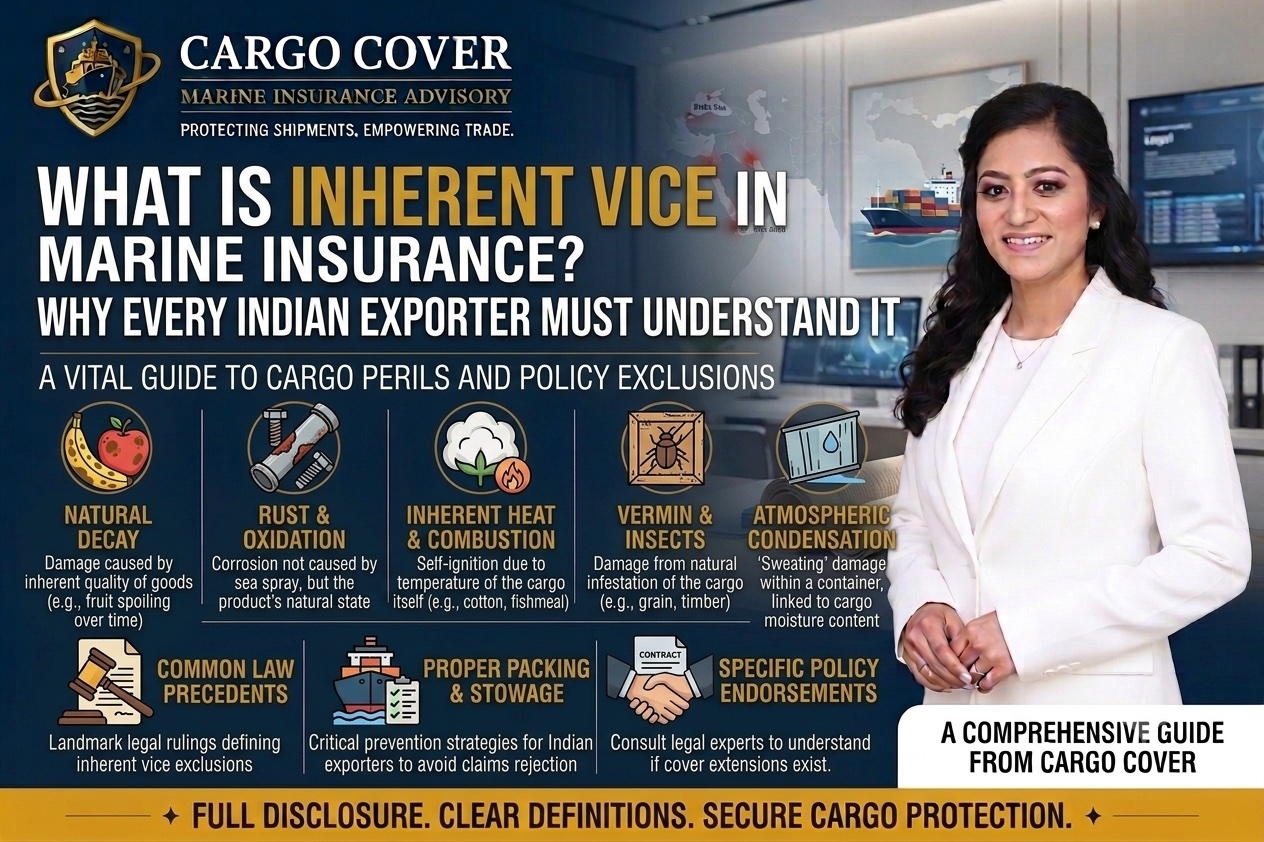
What This Guide Covers
Inherent Vice is the most misunderstood exclusion in Indian marine insurance — and one of the most expensive when it catches exporters unprepared. This guide explains it completely, with commodity-specific examples, real INR consequences, and exactly what you can do to protect your cargo and your claims.
What Is Inherent Vice in Marine Insurance?
Inherent Vice is the natural tendency of a cargo to damage, deteriorate, or destroy itself due to its own internal characteristics — without any external marine peril being the cause. It is one of the most important exclusions in all marine cargo insurance, and it applies to ICC (A) All Risk, ICC (B), and ICC (C) equally — without exception.
The word "inherent" means built-in, intrinsic, inseparable from the thing itself. The word "vice" in this legal context means defect, fault, or harmful quality. Put together: Inherent Vice is a defect or harmful quality that exists within the cargo itself, causing damage that would occur regardless of how carefully the cargo was handled, regardless of the vessel quality, and regardless of the transit conditions — simply because the commodity's own nature makes deterioration inevitable.
The Simplest Way to Understand Inherent Vice
Ask this question about any cargo loss: "Would this damage have happened anyway — even on a perfect voyage, with a perfect vessel, under perfect handling?" If the answer is yes — because the cargo itself was already deteriorating from within — that is Inherent Vice. If the damage required an external trigger — a collision, water ingress, fire, theft — that is a marine peril and may be covered under your ICC clause.
Natural Deterioration
Fruit ripening and rotting during a long voyage. Vegetables wilting. Grain fermenting. Tea losing flavour. These natural processes continue regardless of any external event — they are the inherent nature of perishable commodities.
Moisture Already Present
Spices packed with excess moisture content deteriorating in transit. Cotton bales developing mould because moisture was present at stuffing. The moisture was inside the cargo at loading — not introduced by sea water or rain during the voyage.
Chemical Reactivity
Chemicals that are naturally reactive and begin degrading from the moment of manufacture. Oxidation of edible oils due to their inherent chemical composition. Pharmaceutical compounds breaking down because of their natural molecular instability at ambient temperatures.
Pre-existing Infestation
Grain or rice infested with weevils at the time of loading — the infestation was already present and would have continued regardless of the voyage. The damage at destination is the result of what was already happening inside the cargo at the moment of shipment.
Spontaneous Combustion
Coal, certain chemicals, and agricultural products that are prone to self-heating and spontaneous combustion. If the cargo's own internal heat generation causes fire — without an external ignition source — this can be classified as Inherent Vice rather than an insured peril.
Natural Evaporation & Leakage
Liquid cargo that naturally evaporates or seeps through its own container due to the physical properties of the liquid. Ordinary leakage of liquids in bulk tankers attributable to the nature of the commodity rather than an insured event.
ICC Clause 4.4 — The Exact Words Every Exporter Must Know
Inherent Vice is not buried in fine print or hidden in a schedule. It is prominently stated in the standard exclusions of every ICC clause issued anywhere in the world, including India. Here is the precise legal framework:
"In no case shall this insurance cover loss damage or expense caused by inherent vice or nature of the subject-matter insured."
This clause appears identically in ICC (A), ICC (B), and ICC (C). The phrase "in no case" is the strongest possible exclusionary language in insurance drafting — it leaves no room for interpretation, no exceptions, no circumstances under which inherent vice is covered. Every Indian exporter must understand that this exclusion applies regardless of which ICC clause their policy uses.
Statutory Basis of the Inherent Vice Exclusion in India
Section 55(2)(c) of the Marine Insurance Act, 1963 provides the statutory foundation: "Unless the policy otherwise provides, the insurer is not liable for inherent vice or nature of the subject-matter insured." This means the exclusion is not merely contractual — it is embedded in Indian statute. An insurer cannot be contractually forced to waive this exclusion, and courts in India will apply it strictly when the proximate cause of a loss is established as the cargo's own nature.
Ordinary Leakage, Ordinary Loss in Weight or Volume, Ordinary Wear and Tear
Clause 4.2 excludes "ordinary leakage, ordinary loss in weight or volume, or ordinary wear and tear of the subject-matter insured." This is a companion exclusion to Inherent Vice — covering the predictable, normal consequences of a commodity's own nature during transit. A rice exporter should not expect to claim for 0.5% weight loss due to natural moisture evaporation during a long sea voyage — this is ordinary loss in weight excluded under Clause 4.2.
⚠️ The "All Risk" Misconception: ICC (A) All Risk is the broadest available marine cargo cover — but "All Risk" does not mean all losses from all causes. It means all risks of physical loss or damage from external causes, subject to the named exclusions in Clause 4. Inherent Vice (Clause 4.4) is a named exclusion that explicitly carves out this category of loss from even the most comprehensive ICC clause available. Many Indian exporters only discover this when their claim is rejected.
Inherent Vice vs Marine Peril — The Distinction That Determines Your Claim
The most practically important concept in Inherent Vice is understanding how it differs from a covered marine peril — and recognising that the line between them is often blurred, frequently disputed, and ultimately determined by the proximate cause test. Getting this distinction right is the difference between full settlement and zero recovery.
| Situation | Is It Inherent Vice? | Or a Marine Peril? | Claim Outcome |
|---|---|---|---|
| Spices arrive mouldy — pre-packed with excess moisture | ✔ Inherent Vice — moisture was at loading | — | ❌ Claim rejected |
| Spices arrive mouldy — sea water entered container through damaged seal | — | ✔ Marine Peril — external sea water ingress | ✅ ICC (A) covered |
| Seafood spoiled — not blast-frozen to correct temperature before loading | ✔ Inherent Vice — deterioration began at loading | — | ❌ Claim rejected |
| Seafood spoiled — reefer compressor failed mid-voyage | — | ✔ Marine Peril — mechanical failure (Reefer add-on) | ✅ Reefer Breakdown add-on covers |
| Cotton bales develop mould — high moisture at stuffing | ✔ Inherent Vice — moisture present at loading | — | ❌ Claim rejected |
| Cotton bales develop mould — container flooding during storm | — | ✔ Marine Peril — sea water ingress from storm | ✅ ICC (A) covered |
| Pharma batch degrades — improper pre-shipment storage temperature | ✔ Inherent Vice — degradation began before loading | — | ❌ Claim rejected |
| Pharma batch degrades — cold chain broken by reefer failure at sea | — | ✔ Marine Peril — reefer failure (add-on required) | ✅ Reefer Breakdown add-on covers |
| Coal self-heats and catches fire — pre-existing high moisture content | ✔ Inherent Vice — coal's own properties | — | ❌ Inherent Vice exclusion applies |
| Edible oil oxidises — natural oxidation during 45-day voyage | ✔ Inherent Vice — natural oxidation | — | ❌ Ordinary deterioration excluded |
🎯 The Cargo Cover Test: When we assess any commodity for insurance, we ask: "What would happen to this cargo if the voyage were perfect — perfect vessel, perfect handling, no external events?" If the cargo would still deteriorate due to its own nature, that deterioration is Inherent Vice. If the cargo would arrive in good condition on a perfect voyage but was damaged by a specific transit event, that is a marine peril. The better your cargo's pre-shipment condition is documented, the easier it is to establish that any damage at destination was caused by the transit event — not the cargo's own nature.
Proximate Cause — How Insurers and Courts Decide Inherent Vice Claims
The determination of whether a loss is caused by Inherent Vice or by a marine peril ultimately turns on the legal doctrine of proximate cause — the dominant, real, effective cause of the loss, as opposed to a remote or contributing cause. This is established under Section 55(1) of the Marine Insurance Act, 1963.
The proximate cause question in every disputed Inherent Vice case is: What was the real, dominant cause of this loss — the cargo's own internal nature, or an external insured event? The survey report, pre-shipment inspection certificates, laboratory analysis, and voyage weather records all feed into this determination.
❌ When Inherent Vice Is the Proximate Cause
Situation: Kerala black pepper arrives at Rotterdam with mould. Moisture content at loading: 14% (above safe limit of 11%). Voyage conditions: normal. No sea water ingress confirmed.
Proximate cause analysis: The dominant cause of the mould is the excessive moisture already present in the pepper at the time of packing. The voyage merely provided time for the pre-existing moisture to cause the damage that was inevitable from the moment of loading.
Outcome: Inherent Vice. Claim rejected. ₹12 lakhs lost.
✅ When a Marine Peril Is the Proximate Cause
Situation: Same Kerala black pepper with correct 10% moisture content at loading. During voyage, container door seal fails — sea water enters container during Bay of Bengal storm.
Proximate cause analysis: The dominant cause of the mould is the sea water that entered through the failed seal — an external marine peril. The pepper's own moisture content was within safe limits at loading. The transit event caused the damage.
Outcome: Marine Peril — sea water ingress. ICC (A) claim. ₹12 lakhs settled.
The Evidence That Determines Proximate Cause
Pre-shipment Laboratory Certificate
A certified lab analysis of moisture content, microbial load, chemical purity, or biological condition at the time of packing — is the single most powerful document for establishing that the cargo was in sound condition when loaded. Without this, the insurer can argue the damage was pre-existing.
Pre-shipment Photographic Evidence
Photographs of the cargo at packing — showing condition, moisture levels, packaging integrity — establish a baseline that makes it far harder for an insurer to attribute destination damage to pre-existing Inherent Vice rather than a transit event.
Voyage Weather Records
Official meteorological records for the voyage route and period — establishing whether adverse weather, extreme temperatures, or humidity conditions during the voyage could have caused the damage independently of any inherent characteristic of the cargo.
Arrival Survey Report
A detailed marine survey report from a certified, ICICI Lombard-approved surveyor — documenting the pattern of damage, the condition of packaging and seals, and — critically — whether the damage pattern is consistent with an external event or an internal deterioration process.
Pre-shipment Inspection Certificate
An independent pre-shipment inspection certificate from a recognised inspecting authority (SGS, Bureau Veritas, Intertek) certifying the cargo's condition, quantity, and quality at the point of loading — creates a strong evidential baseline against which arrival condition is measured.
Packing and Packaging Records
Documentation of the packing method, packaging materials, moisture barriers, desiccants used — establishing that the packing met industry standards for the commodity and transit duration. Sub-standard packaging is often used by insurers as evidence of an inherent vice argument.
Indian Export Commodities Most at Risk from Inherent Vice — Detailed Advisory
Certain commodities are structurally more vulnerable to Inherent Vice claims than others — because their natural characteristics make deterioration more likely during export transit, particularly on long-haul routes from India to Europe, USA, Japan, and Australia. Every Indian exporter of these commodities must understand the specific Inherent Vice risks they face.

Search
Recent Posts
- Consequential Loss / Delay in Start-Up (DSU) — Marine Cargo Add-On Cover | CargoCover Advisory
- Concealed Damage / 90-Days Discovery Clause — Marine Cargo Add-On Cover | CargoCover Advisory
- Jettison & Washing Overboard Clause — Marine Cargo Add-On Cover | CargoCover Advisory
- Spontaneous Combustion Cover — Marine Cargo Add-On Cover | CargoCover Advisory
- Leakage & Breakage Cover — Marine Cargo Add-On Cover | CargoCover Advisory


Leave a Comment