cargocoverindia@gmail.com - GST NO. : 23ASHPA0569P1ZM
- Send Email


Posted by Admin on July, 04, 2026
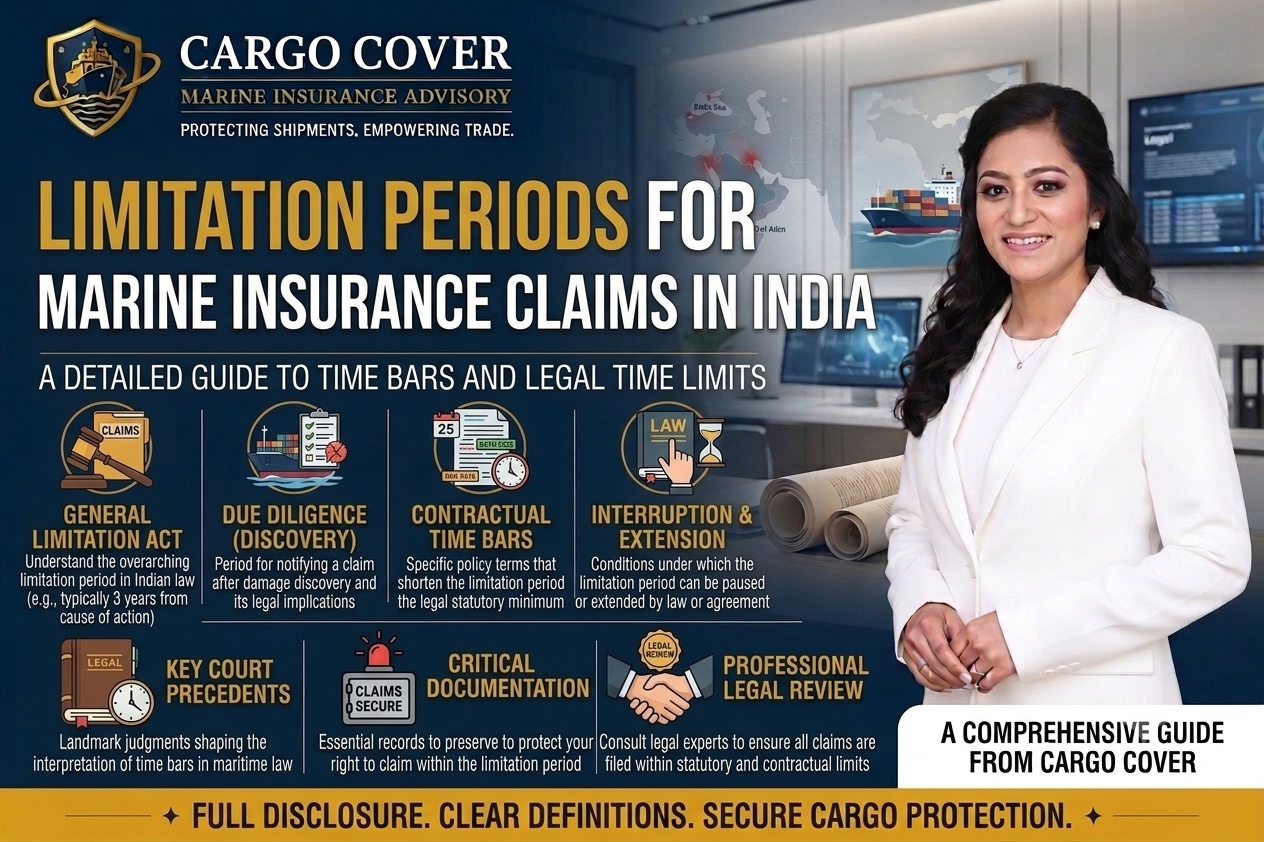
What Is the Limitation Period for
Marine Insurance Claims in India?
A valid marine cargo claim can still be lost entirely if it isn't filed in time — regardless of how clear the damage or how strong the evidence. Indian exporters frequently confuse policy-level notice requirements with statutory limitation periods, and the gap between the two has cost claims that were otherwise fully payable. This guide explains exactly how long you have, where that time limit comes from, and how to make sure you never run out the clock on a valid claim.
CargoCover India · www.cargocover.in · +91-9967084520 · cargocoverindia@gmail.com · Backed by ICICI Lombard — Nibhaye Vaade
Why "Limitation Period" Is the Most Misunderstood Term in Marine Insurance
Most exporters assume that as long as the cargo damage is genuine and well-documented, a claim will eventually be paid. This is not correct. Marine insurance claims — like nearly all legal and contractual claims in India — are subject to time limits. Once that time limit expires, the claim can be rejected on procedural grounds alone, regardless of how strong the underlying evidence is.
The confusion arises because there are actually three separate and overlapping time considerations that apply to a single marine cargo claim in India: the policy's own notice-of-claim requirement, the documentation submission timeline typically expected by insurers, and the statutory limitation period under Indian law for filing a legal suit if the claim is disputed or unresolved.
Exporters who only think about the first of these — and assume the rest will "sort itself out" — are the ones most likely to discover, months later, that a procedural deadline has already passed.
Notice Period vs Documentation Window vs Statutory Limitation
These three timelines apply at different stages of a single claim. Missing any one of them can independently jeopardise the claim, even if the others were met correctly.
| Timeline | Source | Typical Duration | What Happens If Missed |
|---|---|---|---|
| 1. Notice of Claim / Loss | Policy wording & Institute Cargo Clauses (Clause 15 — "Minimising Losses") | As soon as practicable — often "immediately" upon discovery | Delayed notice can be used by the insurer to argue prejudice — evidence degraded, mitigation opportunities lost. |
| 2. Documentation Submission | Insurer's standard claims process / policy terms | Often within 30 days of notice, though varies by insurer | Incomplete or late documentation can stall processing indefinitely, effectively running out informal goodwill even before any legal deadline applies. |
| 3. Statutory Limitation for Legal Suit | Indian Limitation Act, 1963 — Article 44 (compensation for breach of contract) | Generally 3 years from the date the cause of action arises | A claim becomes legally time-barred — courts can refuse to hear a suit filed after this period, even if the underlying facts are undisputed. |
Important Note on the 3-Year Figure: The Limitation Act's general 3-year period for contract-based claims is the most commonly cited reference point for marine insurance disputes in India, but the exact applicable article and starting point can depend on the specific facts of the case, the policy wording, and any rejection or repudiation correspondence from the insurer. This article is for general guidance only and is not legal advice — exporters facing an active dispute should consult a lawyer for advice specific to their situation.
When Does the Limitation Clock Actually Start?
One of the most contested points in marine insurance disputes is determining exactly when the "cause of action" arises — because the statutory limitation period runs from that date, not from the date the cargo was shipped or even the date damage was discovered.
For many claims, the relevant date is when the cargo owner first discovered (or should reasonably have discovered) the damage or loss — often at the point of delivery and inspection.
If a claim was filed and subsequently rejected, the limitation period for a legal challenge often runs from the date of that formal rejection or repudiation letter — making this date critically important to document and retain.
If the exporter pursued an internal review or grievance process with the insurer before escalating, courts have sometimes treated the final decision in that process as the relevant trigger — though this is fact-specific and frequently disputed.
Why This Ambiguity Is Dangerous: Because the exact trigger point can be disputed, exporters should never assume they have the "full" 3 years from an arbitrary date. The safest approach is to treat the clock as having started from the earliest plausible date — discovery of loss — and act well within that window rather than relying on a later, more favourable interpretation holding up in court.
Institute Cargo Clauses — What They Say About Notice and Time
Standard Institute Cargo Clauses (ICC) — used in the vast majority of Indian marine cargo policies — include specific obligations around timely notice and claim documentation, separate from the statutory limitation period.
| ICC Provision | What It Requires | Practical Implication |
|---|---|---|
| Duty of Assured (Clause 16) | The cargo owner must take reasonable measures to avert or minimise loss, and ensure rights against carriers are properly preserved | Delay in acting, even informally, can be characterised as a failure of this duty — supporting a reduced or rejected claim. |
| Notice of Claim Provisions | Most policies require notice "as soon as possible" or "without delay" upon discovery of loss | Vague wording like "as soon as possible" is often interpreted strictly by insurers when a claim is contested — treat this as meaning within hours or days, not weeks. |
| Documentary Evidence Requirements | Survey reports, Bill of Lading, commercial invoice, packing list, and notice of claim correspondence to carriers within their own time limits | Carrier liability claims (separate from the insurance claim itself) often have shorter time bars — sometimes as little as a few months under Carriage of Goods by Sea Act or Hague-Visby Rules. |
A Hidden Trap — Carrier Time Bars: Many exporters focus entirely on the insurance claim and forget that filing notice against the shipping line or carrier (to preserve subrogation rights for the insurer) often has its own, much shorter deadline — sometimes as short as a few months from delivery. Missing this carrier-notice deadline can reduce what the insurer is able to recover, indirectly affecting how generously they settle your claim.
From Damage Discovery to Resolution — A Practical Timeline
Cargo inspected at destination, damage identified. The earliest, most valuable evidence window begins here.
Formal claim intimation submitted — this should happen immediately, not after internal deliberation about whether to file.
Separate, often shorter-deadline notice to the shipping line preserving subrogation rights — frequently overlooked.
Surveyor inspection, photographs, and full documentation package (invoice, packing list, Bill of Lading, survey report) compiled.
Insurer evaluates the claim. Most are resolved through this process without needing to invoke statutory limitation.
If the claim is disputed or rejected, the statutory limitation period for a legal suit becomes the operative deadline — generally counted from this point.
Why Exporters Run Out of Time Without Realising It
Very few exporters deliberately delay a claim. Instead, time is lost through a series of individually reasonable-seeming decisions that compound into a serious problem:
"Let's try to resolve this informally with the buyer first." Months pass in commercial negotiation before any formal claim is filed with the insurer.
"We're waiting for the final survey report before filing." Notice of claim should not wait for the full survey — initial notice and full documentation are separate steps.
"The insurer asked for more documents, so we're working on that." Repeated documentation requests can stretch over months without anyone tracking the cumulative time elapsed since the original loss.
"We assumed the rejection letter wasn't final, so we kept following up informally." Informal follow-up does not necessarily pause the limitation clock — formal escalation matters.
6 Ways CargoCover Helps Exporters Stay Within the Claim Window
Our 2-hour surveyor activation also means immediate, documented notice to the insurer — removing the "we'll file it later" delay pattern entirely.
We help ensure notice to the carrier is filed alongside the insurance claim — protecting subrogation rights and avoiding the often-overlooked shorter carrier deadline.
We track every document request and submission date, so the cumulative time elapsed is always visible — not buried in email threads.
If a claim is disputed or rejected, we help identify and record the relevant date clearly — critical if the matter needs to be escalated within the statutory window.
Rather than waiting for informal negotiation to run its course, we advise on when a claim needs formal escalation — protecting the exporter's legal options well before any deadline approaches.
A well-resourced insurer with established claims processes tends to resolve valid claims faster — reducing the chance that a claim drags on long enough to approach any limitation concern.
5 Limitation-Related Mistakes Indian Exporters Make
Negotiating a commercial discount or adjustment with your buyer does not pause the insurance claim clock — file the formal claim with your insurer regardless of parallel buyer discussions.
Initial notice of loss should happen immediately upon discovery — the detailed survey and documentation can follow, but the clock for "prompt notice" starts at discovery, not at report completion.
Focusing only on the insurance claim while missing the carrier notice deadline can compromise the insurer's ability to recover from the carrier — sometimes affecting your own settlement indirectly.
This single date can determine when the statutory limitation period starts running — losing track of it removes your ability to confidently calculate how much time remains.
An ongoing review does not necessarily stop the statutory clock. If months are passing without resolution, get formal advice on whether protective legal steps are needed even while the claim is technically "under review."
Limitation Period Questions — Common Exporter Concerns
A: The 3-year period under Article 44 of the Limitation Act, 1963 is the commonly cited general rule for contract-based claims, but the exact figure and starting date depend on the specific facts, the applicable article, and any rejection correspondence. This is general guidance, not legal advice — consult a lawyer for your specific situation.
A: A long pending period without resolution is worth flagging for review — both to push for a decision and to understand whether any protective steps should be taken regarding the limitation period, even while the claim remains technically open.
A: Notice of claim is the initial step of informing your insurer of a loss, governed by policy terms and ICC clauses. Filing a legal suit is a formal court action, governed by the Limitation Act — and is typically a last resort if the insurer's claims process does not resolve the matter satisfactorily.
A: CargoCover is a marine insurance advisory desk — we help structure policies, coordinate surveyors, and track claim timelines closely so deadlines are never missed. For an active legal dispute requiring litigation, we recommend qualified legal counsel, and can help coordinate documentation for that process.
A: File formal notice of claim with your insurer immediately upon discovering damage — don't wait for negotiations, full surveys, or "more clarity." Everything else can follow, but the notice itself should never be delayed.
The One-Page Answer
The CargoCover Answer: The safest practice is to act as early as possible at every stage — immediate notice, prompt documentation, and clear tracking of every key date. An Open Policy structured with CargoCover keeps these timelines visible from the moment damage is discovered, so no exporter loses a valid claim simply because a deadline was missed.
Why Exporters Trust CargoCover to Keep Claims on Track
A genuine cargo loss should never be lost on a technicality. CargoCover's Open Policy structure pairs immediate surveyor activation with active claim-timeline tracking — so notice, documentation, and escalation all happen within the window that protects your right to a fair settlement.
From the moment damage is discovered, our desk helps you file formal notice without delay.
We help ensure the often-overlooked carrier notice deadline is met alongside your insurance claim.
Every notice, submission, and insurer response is tracked with a clear date — so you always know where you stand.
A well-resourced insurer behind your policy means faster resolution and fewer claims that drift toward limitation concerns.
Have a Pending Claim? Let's Review Your Timeline
Tell us when the loss occurred and what's happened since. We'll help you understand where your claim stands relative to key deadlines — response within 24 hours.
Backed by ICICI Lombard's claim-settlement track record — one of the highest claim settlement ratios among Indian general insurers for marine cargo.
limitation period marine insurance claims India · marine cargo claim time limit · Indian Limitation Act marine insurance · how long to file marine cargo claim India · marine insurance claim deadline India · notice of claim Institute Cargo Clauses · carrier notice deadline cargo claim · marine insurance claim rejected India repudiation · marine insurance advisory India · ICICI Lombard marine claim · CargoCover Advisory · cargocover.in · cargocoveradvisory.com
This article provides general information for educational purposes and does not constitute legal advice. Limitation periods depend on specific facts and applicable law — consult a qualified lawyer for advice on any active or potential claim.
© CargoCover Advisory · www.cargocover.in · cargocoverindia@gmail.com · +91-9967084520 · Backed by ICICI Lombard — Nibhaye Vaade

Search
Recent Posts
- Consequential Loss / Delay in Start-Up (DSU) — Marine Cargo Add-On Cover | CargoCover Advisory
- Concealed Damage / 90-Days Discovery Clause — Marine Cargo Add-On Cover | CargoCover Advisory
- Jettison & Washing Overboard Clause — Marine Cargo Add-On Cover | CargoCover Advisory
- Spontaneous Combustion Cover — Marine Cargo Add-On Cover | CargoCover Advisory
- Leakage & Breakage Cover — Marine Cargo Add-On Cover | CargoCover Advisory


Leave a Comment